

While Caroline’s recipe for Halloumi and Watermelon Salad is presented as a simple summer dish, from a biochemical perspective, it is a highly sophisticated interplay of osmotic pressure, protein thermodynamics, and neurological sensory manipulation.
To execute this dish perfectly, one must understand the biological mechanics of why the watermelon releases its juices, why the cheese refuses to melt, and how the mint physically tricks your brain’s temperature receptors. Here is the clinical breakdown of this Mediterranean staple.
The Kinetics of Osmotic Maceration
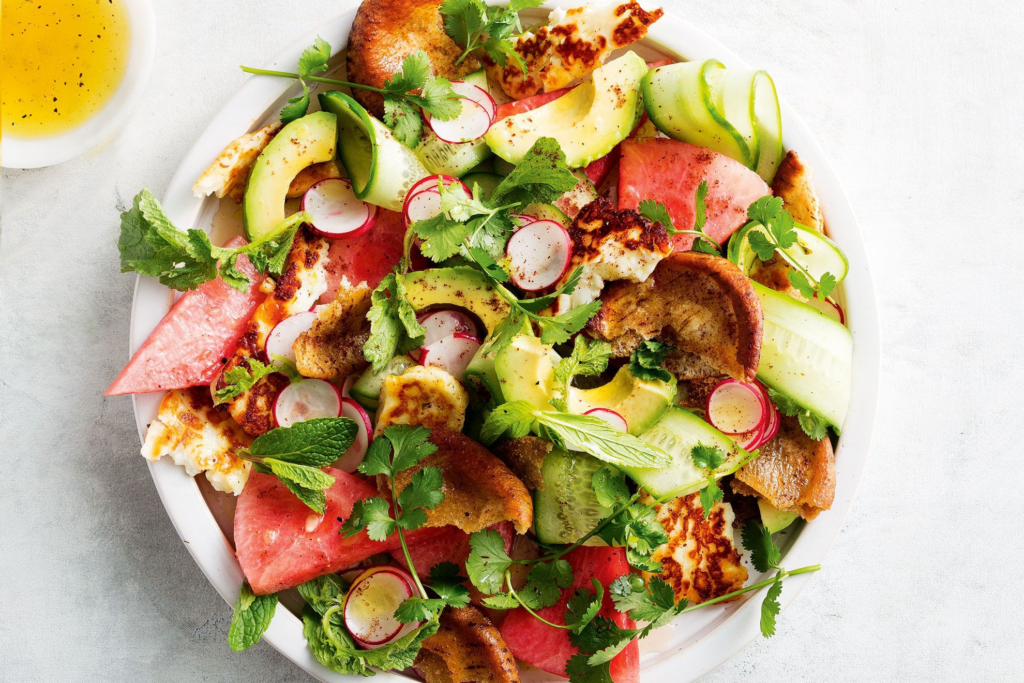
The recipe instructs you to toss the watermelon chunks in a dressing of olive oil, lemon juice, honey, and salt, then let it sit for 10 minutes. This is not simply resting; it is an active biochemical process known as maceration, driven by the laws of osmotic pressure.
Watermelon flesh is approximately 92% water contained within fragile plant cell walls. When you introduce sodium chloride (salt) and citric acid (lemon juice) to the exterior of the fruit, you create a hypertonic environment. The mathematical force drawing the water out of the cells can be modeled by the van ‘t Hoff equation for osmotic pressure ($\Pi$):
$$\Pi = iMRT$$
Where:
- $i$ = The van ‘t Hoff index (for $NaCl$, $i \approx 2$).
- $M$ = Molarity of the solute (the salt/sugar concentration of the dressing).
- $R$ = The ideal gas constant.
- $T$ = Absolute temperature in Kelvin.
Because the molarity ($M$) outside the watermelon is drastically higher than inside, water rapidly diffuses across the cellular membranes into the bowl. This physiological fluid loss concentrates the fructose and lycopene inside the remaining fruit structure, while simultaneously creating a naturally emulsified vinaigrette in the bottom of the bowl.
The Thermodynamics of Non-Melting Cheese
The defining characteristic of Halloumi is its ability to be pan-fried at high temperatures without turning into a liquid puddle. This thermal resistance is due to the specific biochemistry of its casein protein network.
Most cheeses are coagulated using high amounts of acid, which lowers the pH (usually around 5.0) and strips calcium ions away from the casein proteins. When heated, this weakened network collapses, causing the cheese to melt. Halloumi, however, is coagulated almost entirely by rennet (an enzyme) at a remarkably high pH of roughly 6.5.
Because the pH remains high, the calcium-phosphate bridges holding the casein micelles together remain completely intact. When thermal energy is applied in the skillet, the protein matrix mathematically refuses to denature. Instead of melting, the matrix simply squeezes out excess whey and lipid molecules, causing the characteristic “sputter” mentioned in the recipe.
The Maillard Reaction
Because Halloumi maintains its structural integrity under high heat, it allows the cook to safely trigger the Maillard reaction on the surface of the cheese.
At temperatures exceeding 140°C, the nucleophilic amino groups of the casein proteins react violently with trace reducing sugars (lactose) present in the cheese. This non-enzymatic browning creates a dense crust of melanoidins. The result is a highly complex, caramelized, and savory flavor profile that perfectly counterbalances the simple sweetness of the fructose in the watermelon.
Neurogastronomy: TRPM8 Activation
The inclusion of fresh, shredded mint is not merely for visual garnish; it serves a specific neurological function. Mint leaves contain high concentrations of the organic compound menthol.
When consumed, menthol physically binds to the TRPM8 ion channels located on the sensory neurons in your mouth and throat. These specific receptors are biologically designed to detect cold temperatures. By chemically agonizing the TRPM8 receptor, the menthol forces the neuron to fire an action potential to the brain, artificially simulating the sensation of cold. When combined with the high water content of the chilled watermelon, this neurological illusion maximizes the perception of hydration and thermal relief during hot summer months.
Also Read : Remembering Robert Carradine: The Legacy of a Hollywood Legend (1954–2026)