
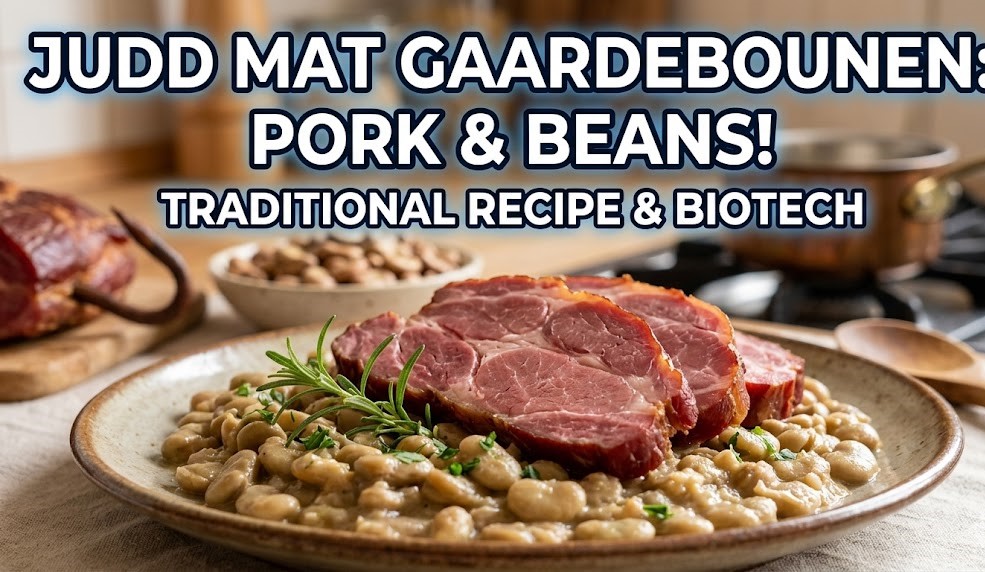

The cultural article provided by Remitly beautifully highlights Luxembourg’s national dish, Judd mat Gaardebounen (smoked pork collar with broad beans). However, from a clinical and biochemical perspective, traditional recipes like this are not merely cultural artifacts; they are empirical laboratory protocols developed over centuries to ensure caloric preservation, mitigate pathogenic bacterial growth, and neutralize naturally occurring plant toxins.
When you soak a smoked pork collar or boil broad beans, you are actively executing thermodynamic and pharmacokinetic processes. Here is the highly detailed, biological breakdown of the chemistry behind Luxembourg’s national dish.
The Thermodynamics of Desalination (Osmotic Kinetics)
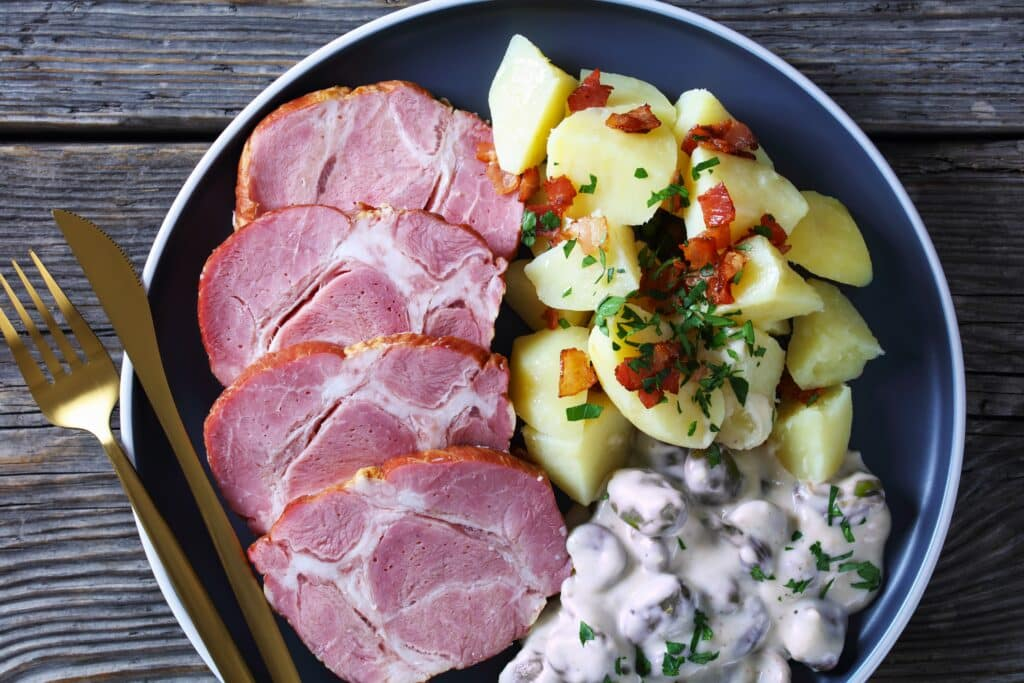
The recipe mandates that the smoked pork collar (Judd) must be soaked in water overnight. Historically, smoking and heavy salt curing were the only biological defenses against microbial putrefaction before refrigeration. The sodium chloride ($NaCl$) acts as a profound desiccant, drawing moisture out of the meat matrix and creating an inhospitable environment for bacterial mitosis.
However, prior to consumption, this hypertonic salt concentration must be reversed to prevent severe sodium overload and cellular dehydration in the human consumer. This overnight soaking process relies on the physical laws of osmotic diffusion. We can mathematically model the rate at which the salt leaves the pork tissue using Fick’s First Law of Diffusion:
$$J = -D \frac{\Delta C}{\Delta x}$$
Where:
- $J$ = The diffusion flux (the amount of salt leaving the meat per unit area per unit time).
- $D$ = The diffusion coefficient (determined by the temperature of the water and the porosity of the pork muscle).
- $\Delta C$ = The concentration gradient (the high salt inside the meat vs. the zero salt in the fresh water).
- $\Delta x$ = The physical thickness of the pork collar.
By continually replacing the soaking water, the cook maintains a steep concentration gradient ($\Delta C$), mathematically forcing the sodium ions out of the intracellular muscle space until isotonic equilibrium is reached.
Collagen Hydrolysis and Thermal Denaturation
After soaking, the pork is simmered “until tender—this can take several hours.” This prolonged exposure to thermal energy is a structural requirement for transforming tough, load-bearing connective tissue into a palatable state.
Pork collar is heavily striated with collagen, a rigid structural protein consisting of three polypeptide chains wrapped in a triple helix. At room temperature, collagen is incredibly tough. However, when sustained thermal energy (between $160^\circ\text{F}$ and $180^\circ\text{F}$, or roughly $71^\circ\text{C}$ to $82^\circ\text{C}$) is applied during a slow simmer, the kinetic energy breaks the non-covalent hydrogen bonds holding the triple helix together.
This thermodynamic unwinding transforms the tough collagen into gelatin. The gelatin binds with the surrounding water molecules, creating the highly coveted “melt-in-your-mouth” texture and a highly viscous, lip-smacking mouthfeel that defines slow-cooked meats.
The Clinical Toxicology of Broad Beans (Favism)
The most clinically significant step in this recipe is the mandatory boiling of the broad beans (Gaardebounen, or Vicia faba). Broad beans are highly nutritious, but they possess a dangerous evolutionary defense mechanism. They contain high concentrations of two toxic $\beta$-glucosides: vicine and convicine.
In a normal digestive tract, these compounds are hydrolyzed by gut bacteria into highly reactive oxidants (divicine and isouramil). For the vast majority of the population, endogenous antioxidants easily neutralize this threat. However, for individuals with a genetic Glucose-6-Phosphate Dehydrogenase (G6PD) deficiency, this oxidative stress is catastrophic.
Without sufficient G6PD enzyme, the red blood cells cannot produce NADPH, stripping them of their ability to repair oxidative damage. Consuming raw or undercooked broad beans triggers rapid red blood cell destruction, a potentially fatal clinical condition known as hemolytic anemia (specifically termed Favism).
The boiling process is an essential biochemical intervention. Thermal energy accelerates the hydrolysis and leaching of these water-soluble glucosides:
$$\text{Vicine} + H_2O \xrightarrow{\Delta} \text{Divicine} + \text{D-glucose}$$
By thoroughly boiling the beans and discarding the water, the cook actively neutralizes the phytochemical toxicity, rendering the legumes safe for human metabolic processing.
The Enzymatic Kinetics of the Sauce (Allicin Synthesis)
The final assembly involves sautéing garlic and onions and combining them with cream. This step activates a highly specific enzymatic reaction.
Intact garlic cloves contain an amino acid called alliin and an enzyme called alliinase, separated in different cellular compartments. When the cook minces or crushes the garlic, the cellular walls are destroyed, allowing the enzyme and substrate to mix. This rapid biological reaction synthesizes allicin ($C_6H_{10}OS_2$), the highly volatile organosulfur compound responsible for the pungent aroma and sharp flavor.
Because allicin is extremely unstable and rapidly degrades when exposed to heat, sautéing the garlic briefly before enveloping it in the heavy cream emulsion stabilizes the flavor profile, trapping the volatile sulfuric compounds within the lipid matrix of the dairy fat.
Conclusion
Judd mat Gaardebounen is far more than a comforting cultural staple from Luxembourg. It is a highly optimized sequence of biochemical reactions. By understanding the Fickian diffusion required to desalinate preserved meat, the thermodynamics of collagen hydrolysis, the critical neutralization of the vicine toxins in broad beans, and the enzymatic synthesis of allicin, we can appreciate traditional gastronomy as a practical application of clinical chemistry and food science.
Also Read : The 2025 Met Gala Red Carpet: “Superfine: Tailoring Black Style”