


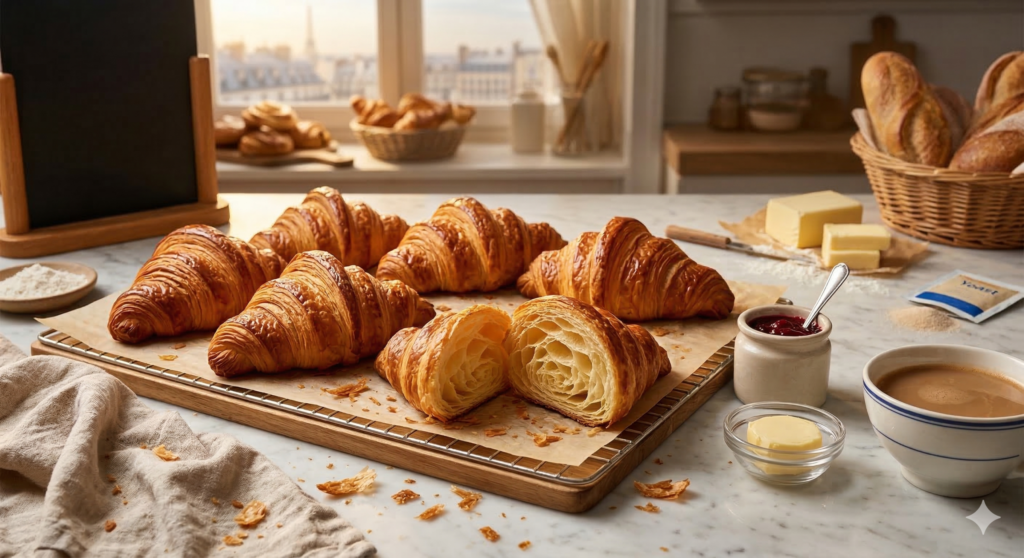
Are you ready to tackle the ultimate baking challenge? Making perfect, authentic French croissants at home is incredibly rewarding. Freshly baked croissants offer a shattering crispness that you simply cannot find in a supermarket.
While the process requires patience, this small-batch recipe breaks everything down into manageable steps over three days. Here is everything you need to know to achieve perfectly flaky, buttery layers!
The Golden Rules of Croissant Making
Before you begin, you must understand a few crucial factors:
- Weigh Your Ingredients: Use a digital kitchen scale. Precision is non-negotiable for authentic croissants, and measuring by weight guarantees consistent results.
- Temperature is Everything: Both your dough (détrempe) and your butter block (tourrage) must remain cold so they do not melt together.
- Pliability is Key: Cold butter is brittle. You must beat your chilled butter with a rolling pin until it becomes bendable (pliable) before rolling it into the dough.
- Do Not Rush: The dough must rest in the fridge between every single fold to allow the gluten to relax.
The Ingredients
The Détrempe (Dough)
- Lukewarm Milk: 85 g
- Lukewarm Water: 60 g
- Active Dry Yeast: 6 g
- Honey (or Malt Syrup/Sugar): 5 g
- Unsalted Butter (melted & cooled): 25 g
- White Sugar: 20 g
- All-Purpose Flour: 250 g
- Salt: 5 g
The Tourrage (Butter Block)
- Unsalted Butter (cold): 140 g (Higher-fat European-style butter is highly recommended!)
Egg Wash
- Egg Yolk: 1
- Milk or Cream: 2 tbsp
Day 1: Make the Dough and Butter Block
1. Activate the Yeast: Dissolve the honey in the lukewarm milk and water. Whisk in the yeast and let it sit for 10–20 minutes until bubbly. 2. Knead the Dough: Add the melted butter, sugar, flour, and salt. Mix into a scraggly dough, then knead on a counter for about 4 minutes until smooth. 3. First Proof: Let the dough rise in a covered bowl for about 1 hour until doubled in size. 4. Freeze the Dough: Knock the air out. Roll the dough into a 7 x 10 inch rectangle. Wrap it tightly in plastic and freeze it overnight. 5. Shape the Butter Block: Slice your 140g of cold butter. Arrange the slices into a 5 x 6.5 inch rectangle on a piece of parchment paper. Fold the paper over the butter and beat it smooth with a rolling pin. Refrigerate overnight.
Day 2: Laminate the Dough (Create the Layers)
1. Prep the Components: Let the frozen dough thaw until it is pliable but still cold. Remove the butter block from the fridge and beat it with a rolling pin until pliable (bendable without snapping). 2. Encase the Butter: Place the butter block on one half of the dough. Fold the other half of the dough completely over the butter and pinch the edges to seal it inside. This is the first step to properly laminating your pastry. 3. The First Fold (Double Fold): * Roll the dough out to 16 inches long.
Day 3: Shape and Bake
1. Final Roll: Roll the rested dough out to a thickness of 4–5 mm and a width of about 9.5–10 inches. 2. Cut the Triangles: Trim the edges perfectly straight. Mark 3.5 inch (9 cm) intervals along one edge, and offset markings on the opposite edge. Connect the marks with a sharp knife to cut 6 clean triangles. 3. Roll the Croissants: Make a tiny 1 cm slit at the wide base of each triangle. Roll the dough up from the base to the tip. Tuck the tip underneath the rolled croissant so it does not unravel during baking. 4. Final Proof: Place the 6 croissants on a lined baking sheet. Cover loosely and let them proof in a warm spot (around 77°F) for 2–3 hours. They are ready when they look puffy and jiggle like Jell-O when you shake the pan. 5. Bake: Preheat your oven to 375°F (190°C). Gently brush the croissants with the whisked egg wash. Bake for 20–30 minutes until deep golden brown. 6. Cool: Let them cool slightly on a wire rack to allow the flaky interior honeycomb structure to set!
Also Read : Oops! Ashley Roberts Accidentally Announces Death of Dick Van Dyke in Major On-Air Blunder