
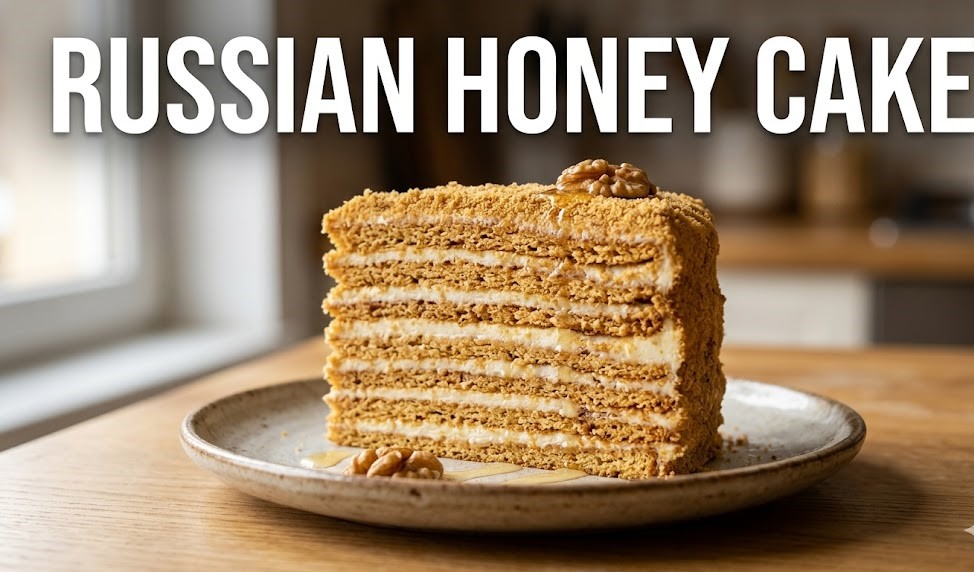

It’s late March 2026, and while the world outside is oscillating between the last gasps of winter and the first blooms of spring, there is no better time for a kitchen project that requires actual culinary stamina. Enter the Medovik (Tort Medovik)—the iconic Russian honey cake. If you’ve ever felt like your kitchen was missing a touch of Imperial-era sophistication, this is it.
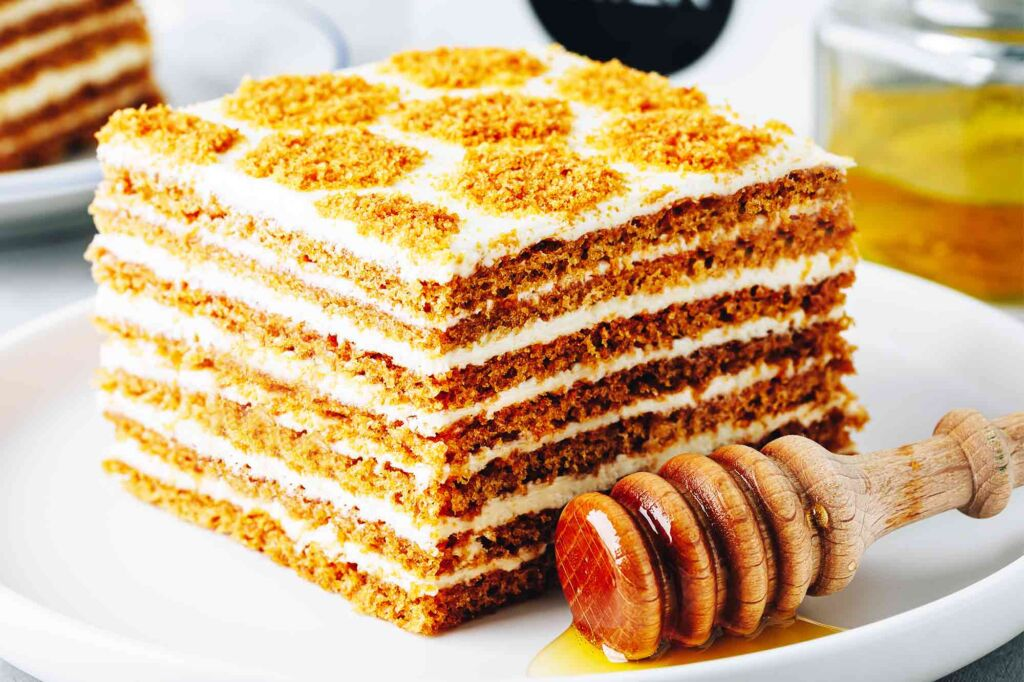
Medovik is essentially the “slow fashion” of the dessert world. You aren’t just baking a cake; you are performing a feat of architectural layering. It is a series of eight honey-infused, cookie-like disks that perform a 24-hour disappearing act into a cloud of sour cream and mascarpone. It’s elegant, it’s historically rich, and it’s undeniably unforgettable.
The Honey Heritage: Why “Med” Matters
In the Russian language, med means honey. Traditionally, this cake was the crowning achievement of any celebration. While some modern iterations use condensed milk, the 2026 “gold standard” remains the balanced tang of sour cream.
The soul of this cake lies in the quality of the honey. According to the National Honey Board’s Guide to Varietals, dark honeys (like Buckwheat or Manuka) offer the deep, caramel-like complexity required to stand up to eight layers of cream. As Julia Frey notes, her grandfather came from a beekeeping family, highlighting that this isn’t just a recipe—it’s a biological legacy.
The Science of the Double Boiler: Controlled Caramelization
The Medovik method is unorthodox. Instead of a liquid batter, you create a warm, pasta-like dough. This is achieved via a Double Boiler (Bain-marie), which ensures the honey and sugar reach a state of controlled caramelization without the bitterness of burning.
The chemical magic happens through the Maillard Reaction, where heat ($T \approx 100^\circ\text{C}$) allows the amino acids and reducing sugars to create that signature golden-brown hue and nutty aroma.
Critical Safety Note: When adding eggs to the hot honey-butter mixture, you must whisk continuously to prevent “scrambling.” You are aiming for an emulsion, not a breakfast dish.
Anatomy of the 8-Layer Build
Precision is the key to the Medovik’s “cult following.” Unlike a standard sponge, these layers are rolled out like thin biscuits before hitting the oven.
| Component | Traditional Role | The 2026 “Vikalinka” Twist |
| Dough | Stiff, honey-based cookie | Kneaded until “pasta-like” for 8 thin layers |
| Filling | Sour cream & sugar | Equal parts Sour Cream and Double Cream |
| Frosting | Plain cake crumbs | Chilled Mascarpone Frosting for stability |
| Texture | Crunchy (initially) | Soft, melt-in-the-mouth (after 24h) |
Step-by-Step Refinement: The Professional Touch
- The “Cookie” Method: Roll each of the 8 dough balls into 7-inch circles. Bake them at $200^\circ\text{C}$ ($400^\circ\text{F}$) for exactly 4–5 minutes. They burn in the blink of an eye, so treat them with the attention you’d give a newborn.
- The 24-Hour Dwell: This is the most important “ingredient.” The cake must sit in the fridge for a full day. This allows the water activity ($a_w$) to reach equilibrium, where the crispy biscuits soak up the moisture from the cream, transforming into a tender, unified cake.
- The “Sharlotka” Alternative: If eight layers feel like a mountain you aren’t ready to climb, you can start with the Russian Apple Cake Sharlotka, which offers a simpler glimpse into Slavic baking traditions.
Conclusion
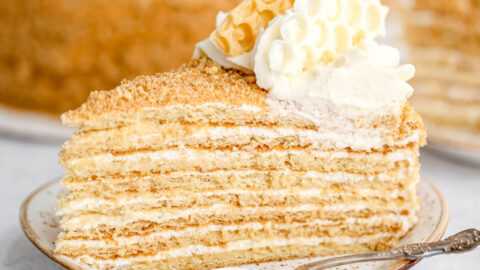
Mastering the Russian Honey Cake is a rite of passage for any baker who values substance over speed. In a world of “instant” everything, the 24-hour wait for a Medovik to soften is a quiet act of rebellion—and your taste buds will reap the rewards. Whether you serve it as a sleek rectangle for a modern dinner party or a tall, 8-layer tower, you’re serving a piece of history on a plate.
Also Read : The Ultimate Guide to the Best Christmas Markets in Europe
