
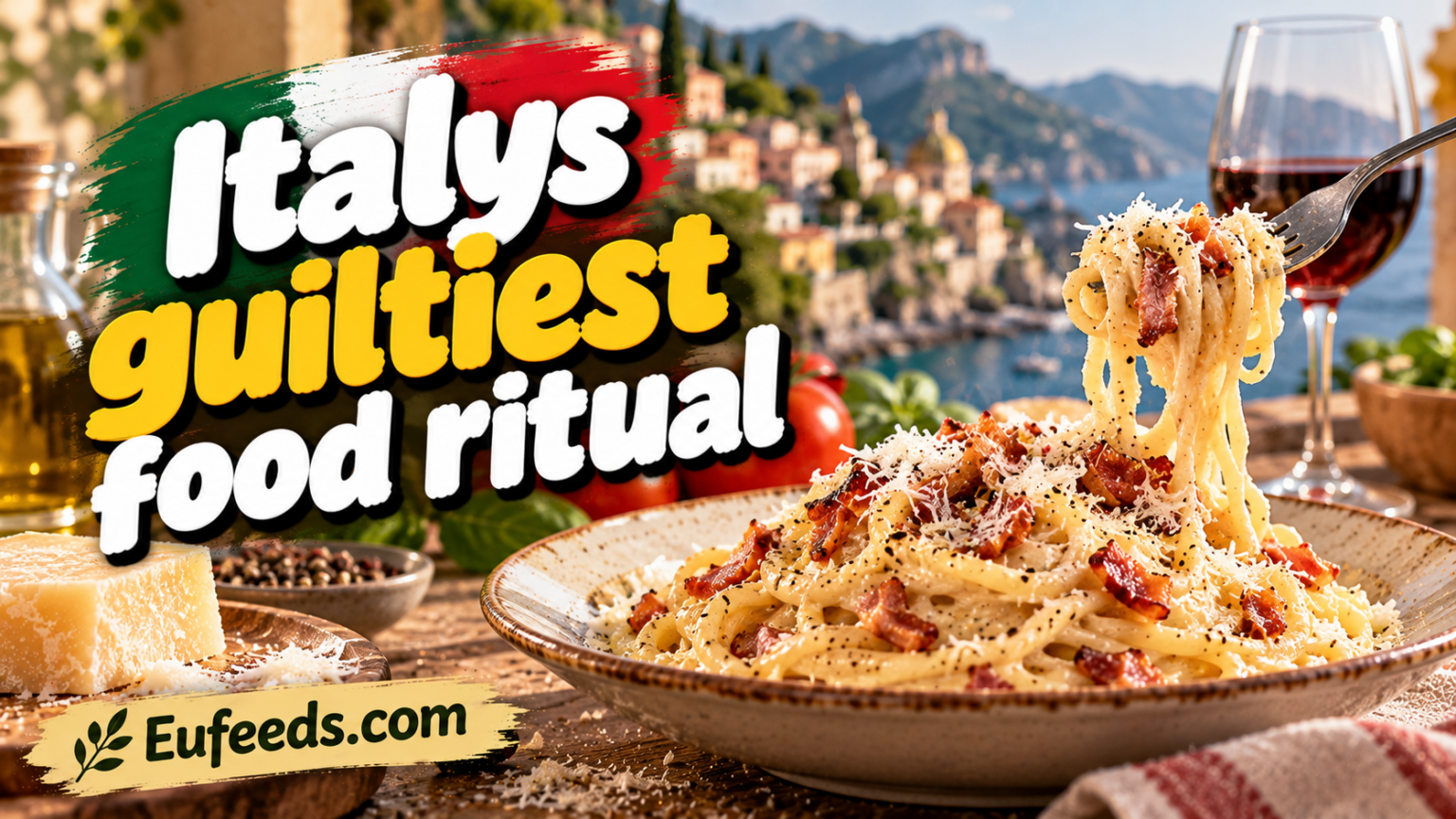

Growing up, I spent a lot of time at my Italian grandparents’ house in Kent, where bread was never not on the table. I remember my nonna slicing it into thick chunks and presenting it in a plastic basket lined with kitchen roll.
We’d eat it throughout lunch or dinner, but its starring role came at the end: mopping up the last of the pasta sauce or soaking up oil and vinegar from the salad. It was, and still is, my favourite part of any meal.
Get to know your expert
Giulia Crouch is a British food journalist specialising in Italian cuisine. She regularly visits family in southern Italy and writes extensively about the country’s food, culture and traditions. She is the author of The Happiest Diet in the World and a certified olive oil sommelier.
These days I’m baffled when my husband leaves good sauce on the plate. “You’ve missed the best bit,” I’ll cry, tearing off a piece of bread to mop up what’s left.
It was only when I got older that I learnt that this ordinary habit has a name in Italy: “fare la scarpetta” – literally “to do the little shoe” – using bread to mop up the last of the sauce or juices from a meal.
On a recent trip to Naples, I was surprised to see la scarpetta done at a white-tableclothed restaurant as casually as at my grandparents’ table. While my Italian dining companion and I were waiting for our pasta dishes to be cleared away, I noticed his eyes darting towards a bit of pesto left on the plate. He eagerly tore off some bread, wiped up every last bit and popped it into his mouth with gusto.
He didn’t ask if I minded or look up to register any kind of disapproval on my face – not that he’d have found any. He just did it with an uninhibited enthusiasm I found oddly life-affirming. It communicated: this food is good and should be thoroughly enjoyed. On the second course, I followed his lead.
How scarpetta got its name
There are many theories online as to why the ritual is called “little shoe”. Some Italians suggest it’s because the piece of bread looks like a small shoe or clog; others suggest it refers to being so hungry you’d eat the sole of a shoe.

Italian food historian Luca Cesari says neither explanation has much evidence behind it. “Its origin is uncertain, so I’d leave aside the more fanciful theories you find online,” he says.
The earliest written example Cesari has found is from 1871, in Roman dialect, when a character in the Roman magazine La Frusta asks to make scarpetta with a little sauce left on the plate.
The expression also appears in an 1885 dictionary of the Abruzzo dialect, suggesting its roots lie in central Italy.
He called it perfectly acceptable – even elegant – as long as it was done with the fingers with nonchalance.
As for the name itself, Cesari says the most convincing hypothesis comes from the Accademia della Crusca, Italy’s leading authority on the Italian language. In central Italian dialect, fare una scarpetta meant “to go for a little walk” – much like the bread taking a stroll around the plate.
Francesca Cipolla, a food content creator from Palermo, Sicily, says scarpetta is instinctive, almost a reflex. “It’s not something we consciously perform. If there’s delicious sauce left on the plate, I tear off a piece of bread and use it to pick up the sauce. I don’t really think about doing it; it’s how I grew up eating, and everyone in my family is the same.”
But the custom has not always been considered good table manners, and attitudes have varied by region, generation and setting.
Chef Gaia Enria who grew up in Turin, one of Italy’s more formal northern cities, remembers being told off by her parents for doing la scarpetta. “It was viewed as improper back then. I think that was specific to Turin. Times have changed now but I remember it clearly.”
In Puglia, chef Somaia Hammad remembers almost the opposite. “In Puglia especially, it can almost be considered rude to leave anything behind on your plate, so finishing every last bit with a piece of bread is as much about showing appreciation for the food as it is about not wasting anything.”

Further south in Calabria, the “toe” of Italy’s boot, chef Francesco Mazzei of Mezzogiorno restaurant in London, remembers a very different relationship with bread. Bread was a food that commanded deep respect. It wasn’t just a vehicle for sauce, it was the integral part of the meal, he explains. In fact, everything else was just a companatico – literally “what you eat with bread”.
“Our lives centred around bread,” he adds “The meal hasn’t begun if there’s no bread on the table and it can’t end without it either.”
When bad manners went mainstream
Cesari cautions, however, that the divide has as much to do with class as geography. He explains that traditional bourgeois etiquette frowned upon touching food with the hands. Even the supposed compromise of breaking bread and spearing it with a fork to mop around the plate could be considered boorish – perhaps more so, because it suggested “someone who would like to follow etiquette but just can’t resist”.
Attitudes started to shift more broadly in the second half of the 20th Century, he says, “as Italy rediscovered its cucina povera and began to think of waste as the real bad manners.”
A symbolic turning point came in 2015, when Gualtiero Marchesi, considered the father of modern Italian fine dining, was defending scarpetta in an interview for Gente magazine. He called it perfectly acceptable – even elegant – as long as it was done with the fingers with nonchalance.
It is now becoming increasingly normal to see Italians doing la scarpetta in restaurants – just as they would at home. “It doesn’t matter if it’s a fancy restaurant, a local trattoria or a bar that does food, they will all serve bread for this purpose and leave it on the table until the end of the meal,” says Cipolla.

In Naples, one takeaway pasta restaurant has built its whole concept around the ritual: at ‘A Scarpetta, every box of pasta has been designed to leave enough sauce for a final mop-up with bread.
These days, says Enria, la scarpettais not only accepted but respected. That’s because, for a small gesture, it can communicate a lot. “But it’s also about pleasure,” she adds. “You want to scoop up every last drop because you enjoyed it so much.”
Mazzei says fare la scarpettahas even become a way of expressing how much you’ve enjoyed something beyond food. “Someone might ask how your holiday was and you could answer ci farei la scarpetta which means I’d do a scarpetta’ or, ‘I wish there was more of it’.”
Perhaps that helps explain how a habit once frowned upon in polite company has become something Italians increasingly love doing in public.
As Cesari puts it: “Leaving something delicious on the plate would be a far worse crime than mopping it up with a piece of bread.”
My nonna taught me well, it seems: good sauce should never go to waste.
Also Read : Authentic Afghan Mantu: The Ultimate Steamed Dumpling Guide
