
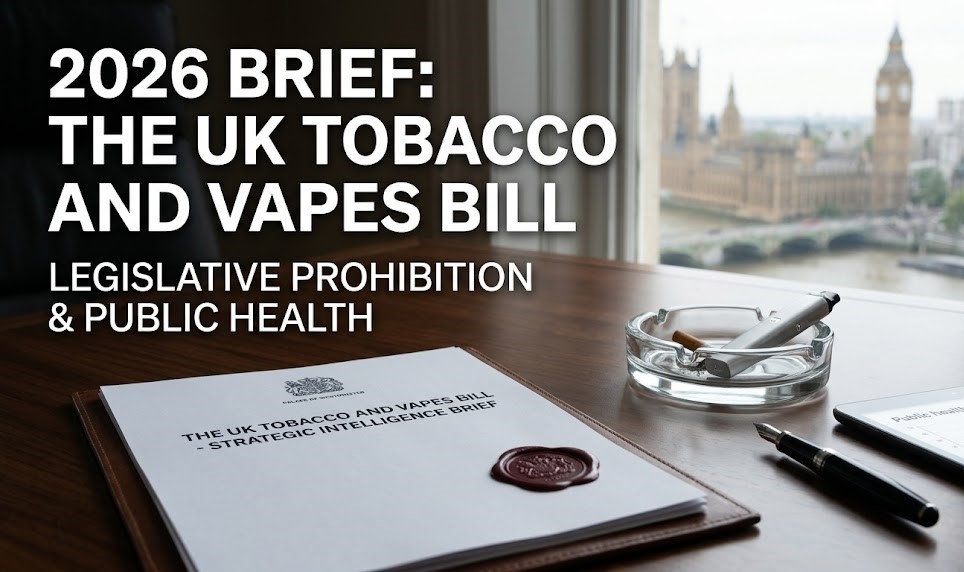

In the public health and legislative sectors of 2026, the United Kingdom has executed one of the most aggressive preventative medicine interventions in modern history. The passage of the Tobacco and Vapes Bill fundamentally alters the legal framework surrounding nicotine consumption, transitioning the state’s posture from passive harm reduction to proactive, generational prohibition. This intelligence brief deconstructs the legislative architecture of the ban, the macroeconomic relief projected for the healthcare system, and the secondary market risks associated with hyper-regulating synthetic nicotine alternatives.
Historical Context and Foundational Evolution
For decades, global Tobacco control relied on taxation, graphic warning labels, and incremental indoor smoking bans to suppress consumption. However, these measures primarily managed the decline of smoking rather than eradicating it. Introduced in November 2024 and officially cleared by the House of Lords in April 2026, the UK’s new legislation bypasses incrementalism. It pioneers a rolling, age-based prohibition model designed to permanently engineer combustible tobacco out of society, creating what Health Secretary Wes Streeting defines as the first truly “smoke-free generation.”
Technical Mechanics and Legislative Architecture
The mechanical execution of this bill relies on a fixed-date demographic cutoff rather than a blanket ban on current consumers.
- The Generational Phase-Out: It is now permanently illegal to sell tobacco products to anyone born on or after January 1, 2009. The legal age of purchase will effectively rise by one year, every year, until the legal market ceases to exist.
- Spatial Prohibition Expansion: The legislation extends existing public space restrictions, granting ministers the power to enforce strict smoking bans outside critical societal hubs, specifically schools, hospitals, and children’s playgrounds.
- Vape Regulation: To prevent the nicotine industry from pivoting its customer acquisition to synthetic products, the bill actively targets Electronic cigarettes. It enforces severe restrictions on branding, promotional packaging, and advertising aimed at youth demographics.
Economic Impact and Healthcare Expenditure
From a macroeconomic perspective, the legislation is a massive, long-term cost-saving measure for the state. Combustible tobacco currently inflicts a catastrophic financial burden on the UK economy. In England alone, smoking is directly responsible for 64,000 deaths and 400,000 hospital admissions annually. This drains £3 billion directly from the National Health Service (NHS) for treatments related to oncology and cardiovascular disease. Furthermore, the broader societal cost—primarily driven by lost workforce productivity—is estimated between £21.3 billion and £27.6 billion annually. By choking off the pipeline of new addicts, the government is securing billions in future Operational Expenditure (OPEX) relief.
Sociocultural and Behavioral Implications
Behaviorally, this legislation signals the terminal decline of smoking as a culturally accepted practice. Charities like Action on Smoking and Health (ASH) and Asthma and Lung UK view this as a decisive historical pivot, shifting the cultural narrative of smoking from an inevitable public health nuisance to a curable, preventable relic of the past. However, the socio-behavioral impact on vaping is more complex. Vapes are being aggressively stripped of their recreational, lifestyle appeal (via flavor and branding bans) and forced back into their original, clinical designation as adult smoking cessation tools.
Regulatory, Ethical, and Industry Pushback
The severing of the legal market naturally introduces friction with industry stakeholders who operate under the philosophy of Harm reduction. Vaping industry advocates, including representatives from VPZ and We Vape, warn of a critical regulatory misstep. They argue that overly restrictive mandates—specifically the suppression of vape flavors and product availability—will remove the primary incentives that convince adult smokers to switch to less harmful alternatives. The ethical dilemma for regulators is balancing the absolute protection of minors against the risk of driving addicted adults back to deadlier combustible tobacco.
Competitive Analysis and Black Market Risks
The most significant strategic vulnerability of this legislation is the inevitable rise of the illicit market. By criminalizing the sale of tobacco to an entire upcoming generation of adults, the state risks creating a highly lucrative vacuum. Transnational smuggling rings and unregulated black markets are highly likely to exploit this demand, providing untested, untaxed tobacco and unregulated vapes to the post-2008 demographic, thereby shifting the burden of enforcement from health departments to border control and local policing.
Predictive Modeling: Global Legislative Domino Effect (2026–2030)
Looking toward 2030, predictive models indicate that the UK’s success in passing this bill will act as a primary catalyst for international policy. We anticipate that allied nations facing similar healthcare deficits will monitor the UK’s implementation of this rolling Smoking ban closely. If the UK can successfully suppress the subsequent black market, this demographic phase-out model will rapidly become the gold standard for global public health legislation, signaling the global endgame for the commercial combustible tobacco industry.
Conclusion
The strategic verdict for April 2026 confirms that the UK Tobacco and Vapes Bill is a monumental victory for preventative public health and long-term economic safeguarding. By permanently outlawing the sale of tobacco to anyone born after 2008, the government is dismantling the cycle of addiction at its inception, rescuing the NHS from billions in future liabilities. However, the ultimate success of this legislation relies on flawless enforcement. The government must now navigate a perilous transition period, ensuring that heavy restrictions on synthetic vapes do not inadvertently paralyze adult harm reduction strategies or trigger an unmanageable explosion in the illicit tobacco trade.
Also Read : Iran–Azerbaijan Conflict: The Nakhchivan Drone Crisis (March 2026)