
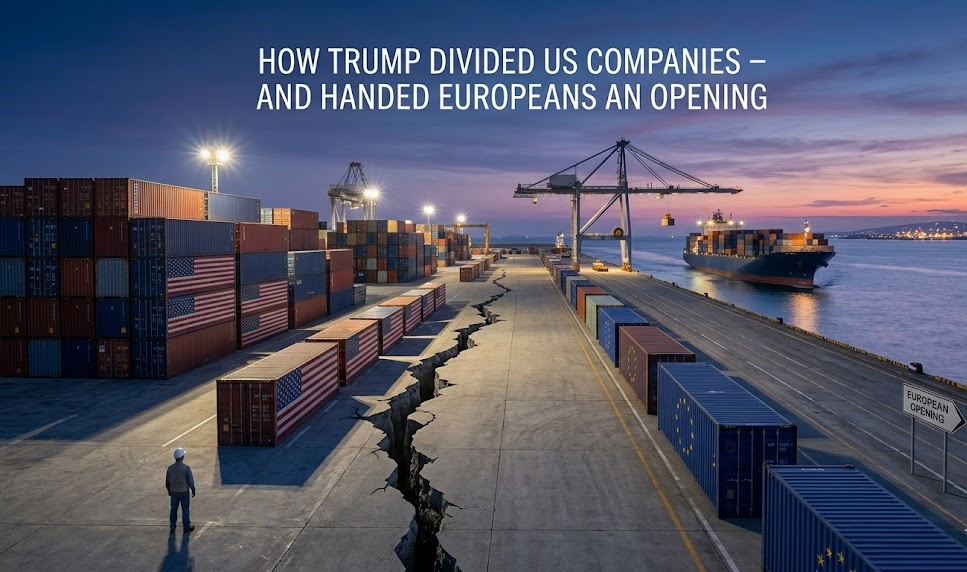

Since Donald Trump returned to the White House in January 2025, his administration has pursued an aggressive trade policy, imposing tariffs on the EU and other partners in an effort to secure more favourable deals.
As part of this approach, Washington has sharply criticised European regulations it views as harmful to U.S. interests and has actively solicited grievances from American businesses to deploy in diplomatic disputes with EU officials.
Yet the administration’s public confrontations with Europe — the United States’ largest trading partner — have divided American companies, many of which fear they could prompt a broader recalibration of EU market-access conditions.
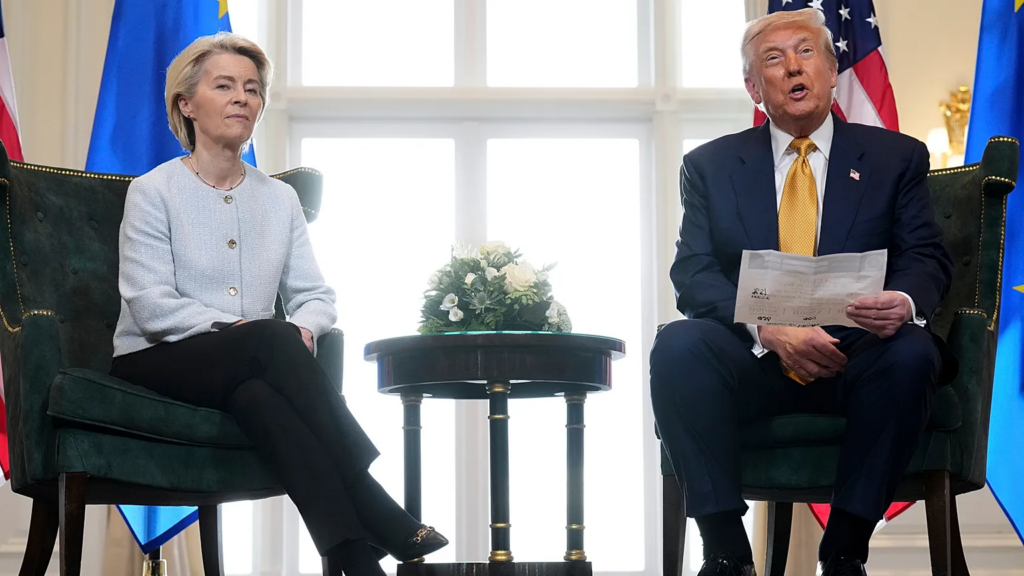
Meanwhile, European businesses are seeking to capitalise on the growing mistrust taking shape during Trump’s second term, hoping it will translate into a commercial opportunity.
Divergent approaches
On the question of Washington’s role in defending U.S. corporate interests, American companies broadly fall into two camps.
Firms pursuing more assertive corporate strategies have been quick to raise concerns directly with U.S. officials, particularly where Brussels is seen as constraining their operations in Europe.
By contrast, a significant share of companies views the administration’s confrontational stance as counterproductive, favouring instead a more conciliatory approach that prioritises stability and continuity.
This divide closely tracks companies’ history in Europe. Newer entrants to the market are generally more inclined to rely on Washington’s backing, while long-established firms — with decades of relationships across European markets — tend to prefer diplomacy over confrontation.
Market positioning is another key factor: consumer-facing companies are often more combative, whereas firms embedded in critical infrastructure and essential services tend to adopt a more cautious tone.
Yet despite these differences, all sides are converging on the same underlying reality: distrust is becoming a structural feature of transatlantic relations.
Weaponising dependencies
U.S. companies have long leveraged their government’s political influence, but the Trump administration has made this dynamic more visible — and at times pushed it to an extent that invites backlash.
In December 2024, U.S. Secretary of State Marco Rubio sanctioned five European citizens accused of facilitating online censorship against U.S. social media platforms, including Elon Musk’s X. Among them was former European Commissioner Thierry Breton, a prominent advocate of platform regulation.
More consequential from a European perspective has been the growing concern over the “weaponisation” of services that have become essential to daily life — from office software and digital platforms to payment systems.
Following the International Criminal Court’s issuance of an arrest warrant for Israeli Prime Minister Benjamin Netanyahu, the U.S. administration sanctioned several ICC officials, who were abruptly cut off from a range of U.S.-based services, including credit cards from Visa and Mastercard, logistics services such as UPS, travel platforms such as Expedia, and apps including Uber and Amazon.
The sweeping impact of these measures exposed the extent of Europe’s dependence on U.S. digital infrastructure, prompting some governments to accelerate efforts to replace tools such as Zoom and Microsoft Office with domestic alternatives.
Call for strategic autonomy
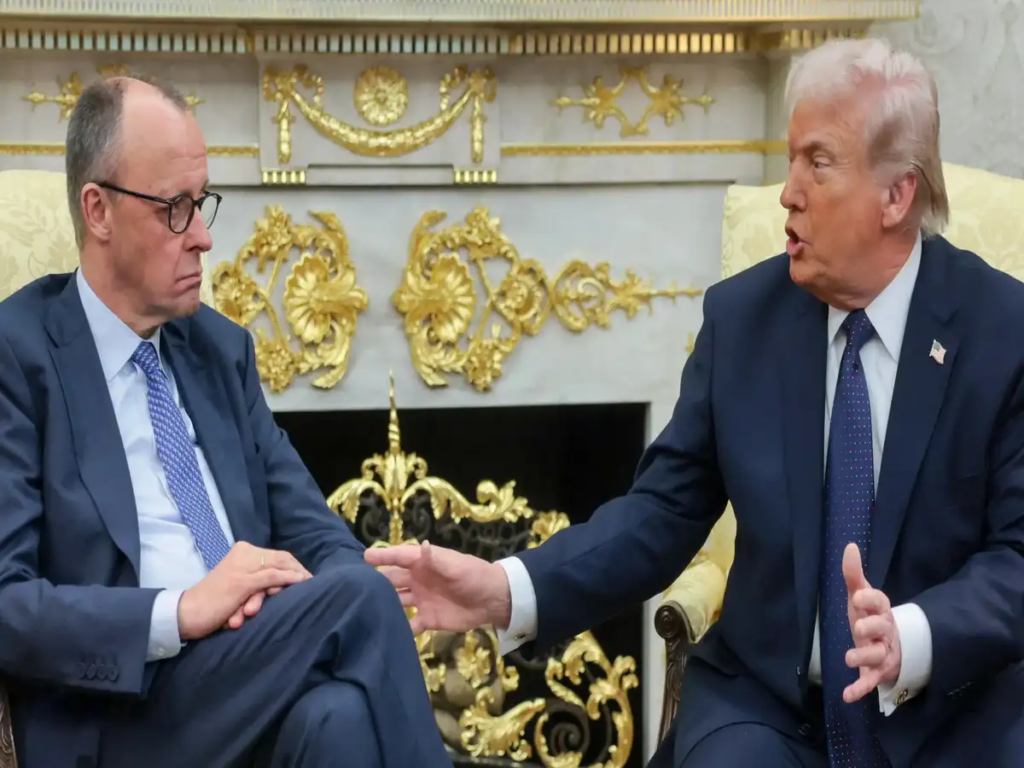
Trump’s second term has reinvigorated debate in Brussels over “strategic autonomy” — the idea that Europe must reduce its reliance on foreign providers whose services could be restricted or repurposed in geopolitical disputes.
EU member states remain divided. A French-led camp advocates a more protectionist approach, favouring direct support for European industry through interventionist economic policy. More export-oriented economies, such as Germany, have traditionally defended open markets.
However, the Trump administration’s more assertive and sometimes unpredictable foreign policy — including territorial rhetoric regarding Greenland — has pushed even traditionally free-market governments such as Denmark and the Netherlands to reconsider their positions.
An early sign of this shift came when the European Commission awarded a €180 million public tender for “sovereign” cloud services to a federation of European companies rather than a U.S. cloud provider.
“The main business developer for the European tech sector is in Washington,” said Sebastiano Toffaletti, Secretary General of the European DIGITAL SME Alliance.
He argued that a federated approach based on interoperability between vendors is better suited to Europe’s fragmented tech landscape, as it reduces dependence on any single operator.
Sovereignty in Trump era
Still, there is no unified European approach to this new geopolitical reality.
Disagreements over the scope of strategic autonomy have already complicated discussions around the Industrial Accelerator Act, with governments split over whether public procurement should prioritise products that are fully “Made in Europe” or more flexibly defined “Made with Europe”, including trusted partners such as Japan and the UK.
A similar debate is expected to resurface in the upcoming European Tech Sovereignty package, which is likely to focus on public procurement in strategic sectors such as defence.
“The Trump administration is giving European companies an opportunity to get a foot in the door and demonstrate whether their solutions can actually work,” said a representative of a U.S. company, speaking on condition of anonymity.
“In a few years, we will see whether these solutions are effective. But the sovereignty question is here to stay — it is not just a temporary fix for the Trump era,” the representative added.
Also Read : The 10 Best Ski Resorts for Non-Skiers in Europe
