


As Chinese-made products are flooding the EU market and threatening thousands of jobs, the European Commission is stepping up its work to protect the bloc’s production from the risks of China’s excess production.
The move comes as data from Chinese customs showed that, in the first four months of 2026, Beijing accumulated a surplus of $113 billion with the EU-27, up from $91 billion over the same period in 2025. The surplus widened by $22 billion over 12 month, while the EU’s trade deficit with China had already reached €359.9 billion in 2025.
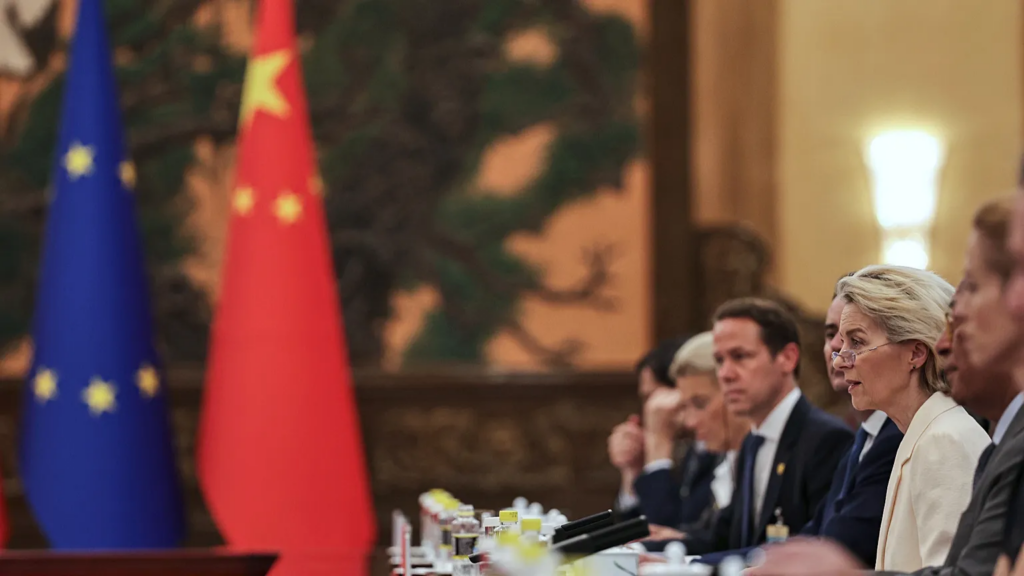
Pressure is also mounting on Brussels as Beijing has repeatedly threatened retaliation in recent weeks over several EU laws limiting access to the single market for Chinese companies.
On Friday, China also banned these companies from engaging with the Commission over EU foreign subsidy investigations.
To address the China issue and try to restore a level playing field, EU Commissioners are set to debate the matter on 29 May. What options does Europe have on the table?
1. Cutting dependence on Chinese components
The Financial Times reported on Monday that a plan to force EU companies to buy critical components from at least three different suppliers was in the pipeline at the European Commission.
The idea would be to set thresholds of around 30% to 40% for what can be bought from a single supplier, with the rest having to be sourced from at least three different suppliers, not all from the same country.
The proposal comes after China last year restricted exports of rare earths and chips, which are critical for key EU industries such as green tech, cars and defence.
2. Targeting strategic sectors with tariffs
In its economic security strategy presented last December, the European Commission also said it would present new tools by September 2026 to strengthen the protection of EU industry from unfair trade policies and overcapacities.
“We will fight tooth and nail for every European job, for every European company, for every open sector, if we see they are treated unfairly,” EU Trade Commissioner Maroš Šefčovič told Euronews.
A decision to impose new quotas and double tariffs on global steel imports, dominated by Chinese overcapacities, was already agreed by EU countries and the European Parliament in April.
Now the chemical industry is in the spotlight. Chinese chemical imports have surged 81% over five years. But the EU chemical sector also relies on exports abroad, including to China, the industry’s fourth export market, which makes any measure targeting China complicated.
“As an export-oriented industry, the European chemical industry generates over 30% of its sales abroad. That creates a risk of retaliation from third countries,” Philipp Sauer, trade expert at Cefic, the lobby group of the European chemical industry, told Euronews.
Related
3. Hitting imports with anti-dumping or anti-subsidy duties
The Commission can also impose duties on Chinese companies when import prices fall below those at which they sell their products on their domestic market. It can also investigate companies for receiving unfair subsidies.
However, investigations can take up to 18 months, and cases are piling up at the Commission’s DG Trade, which has only around 140 officials to handle them.
Sauer said that between one third and half of all ongoing investigations relate to the chemical sector.
4. Using the Anti-Coercion Instrument
The Anti-Coercion Instrument is a last-resort tool — the so-called trade bazooka — which can be used in cases of economic pressure from a third country and would allow the EU to hit China with strong measures such as restricting access to licences or public procurement in the EU.
But its use would require the backing of a qualified majority of member states, which is not guaranteed.
Germany opposed tariffs adopted by the EU in 2024 against Chinese electric vehicles. Spanish Prime Minister Pedro Sánchez, who has visited China four times in three years, also supports closer ties with Beijing, seeking to secure major Chinese investment.
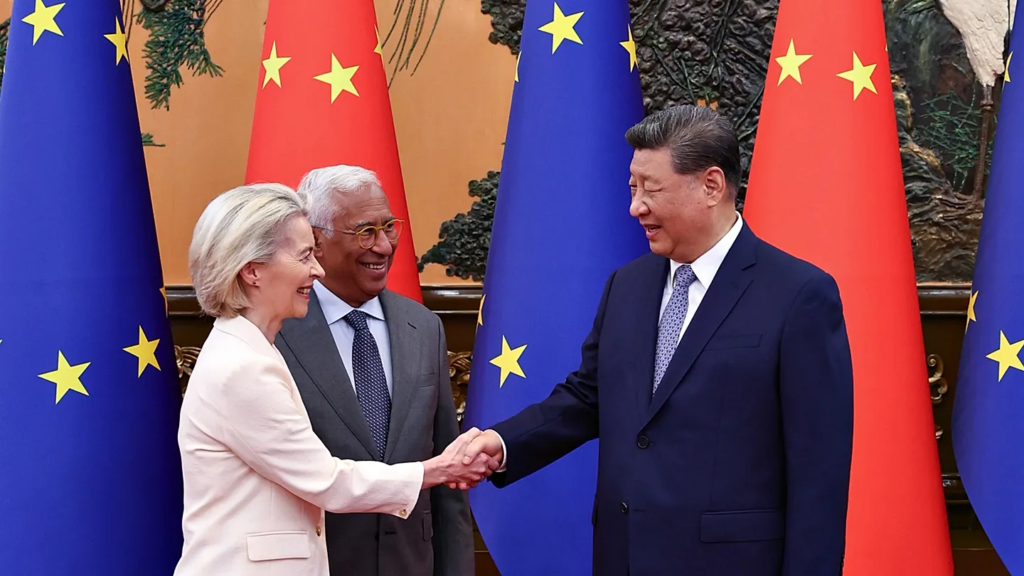
5. Unifying member states
At the same time, Brussels faces the risk that its decoupling strategy might face significant resistance from national governments. EU member states remain divided over how to approach China, which could in turn allow Beijing to play capitals against each other.
Such differences are already emerging in the information and communications technology (ICT) sector, where the EU has proposed a new mechanism requiring the phase-out of so-called high-risk suppliers, such as Huawei and ZTE, in strategic industries, starting with telecommunications.
The proposal, included in the revamp of the EU Cybersecurity Act, is sparking controversy among several European governments, most notably Spain and Germany, which have long worked with Chinese equipment now deeply embedded in their digital infrastructure.
This de-risking strategy has also raised financial concerns, since Chinese suppliers tend to be much cheaper than European alternatives such as Ericsson and Nokia, partly because they are publicly subsidised by Beijing.
European telecom operators have asked the EU for financial compensation to replace their Chinese equipment, following the example of the US “rip and replace” programme, but neither the EU nor national governments seem keen to put the money on the table.
In other words, the EU’s full decoupling from China might have high political and economic costs.
Whether European countries are willing to bear it remains to be seen.
Also Read : Corsican Nationalist Leader Alain Orsoni Shot Dead
