
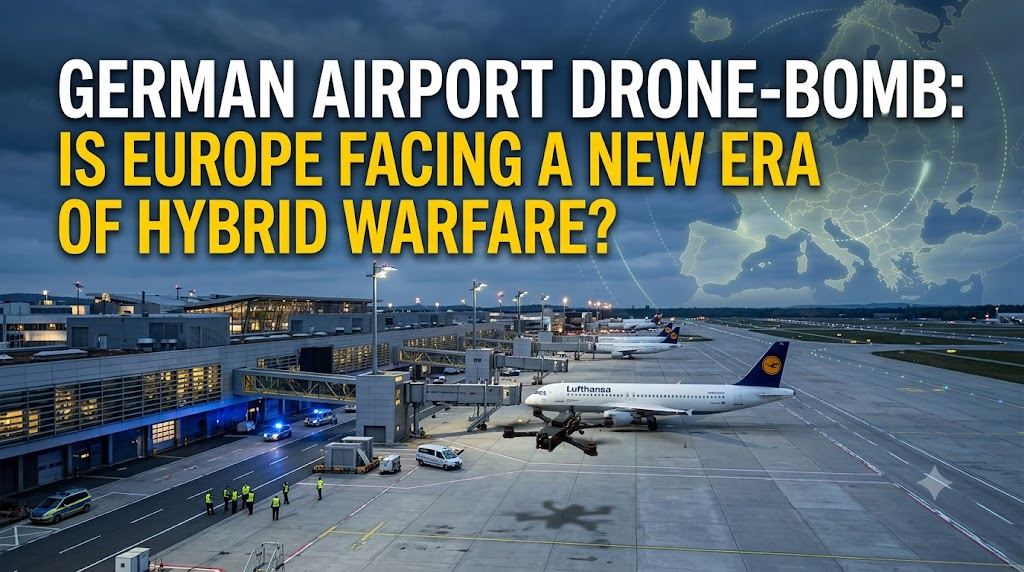

As German authorities investigate how an explosives-laden drone breached a runway at Leipzig airport, European officials are sounding the alarm over a potential escalation in hybrid warfare.
Germany’s interior minister has warned of a “new level of danger” from attacks that may involve foreign powers. While there is no definitive proof yet linking the flying bomb directly to Russia—and Moscow denies any involvement—experts suggest that the Kremlin has both the means and a documented history of similar plots.
Here is a breakdown of the incident, its potential links to past sabotage networks, and what it means for European security.
The Incident at Leipzig Airport
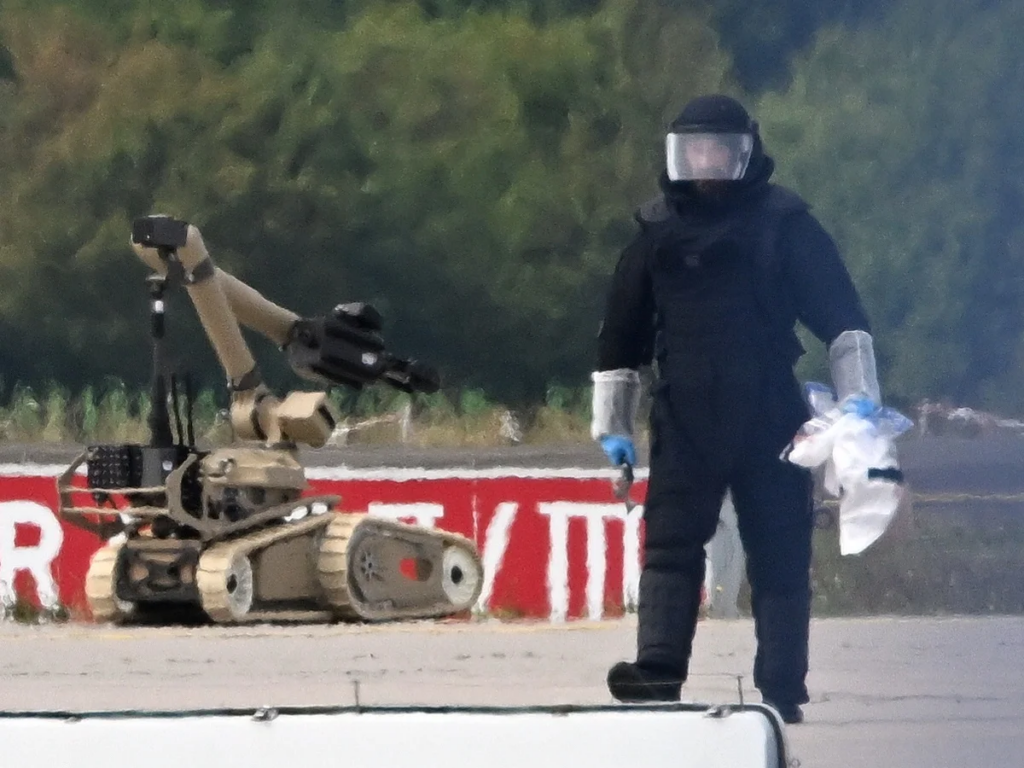
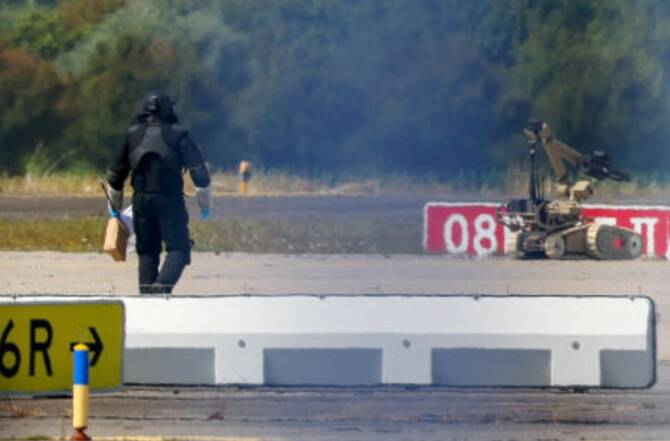
Late Tuesday night, a quadcopter drone was discovered on the tarmac at Leipzig airport, prompting an immediate lockdown of one runway as a bomb disposal robot was deployed.
- The Target Area: The drone was found “floating” among several Ukrainian Antonov cargo planes. These massive aircraft were painted in Ukraine’s blue and yellow flag colors, with one bearing the slogan, “Be Brave Like Kherson.”
- A Second Incident? Around the same time, a DHL cargo plane pulling up into the sky collided with an “unidentified object” and was unable to land at Leipzig. Investigators are still working to determine if this was a second drone.
Echoes of a 2024 Plot
This is not the first time Leipzig has been at the center of aviation security concerns. A previous plot in 2024 provides chilling context to the current investigation.
Earlier this year, a parcel containing a sophisticated incendiary device caught fire at the airport’s DHL hub just before being loaded onto a plane. Similar packages ignited in the UK and Poland. Prosecutors in Lithuania and Poland are currently trying a group of men believed to be a network of proxies recruited by Russian military intelligence.
The Smuggling Network Case documents reveal that these suspects transported significant amounts of RDX explosives (equivalent to 6kg of TNT) around Europe. Their methods were highly covert:
- Explosives were hidden inside cans of sweetcorn and chopped tomatoes.
- Detonators were concealed inside headphone sets.
- Drone components suitable for holding bombs were smuggled, allegedly originating from the Russian exclave of Kaliningrad.
One suspect, a Ukrainian national named Vladyslav D., admitted to investigators that he transported drone components and packages across Lithuania, Poland, and Germany under the direction of a handler known as “Warrior,” receiving over $2,000 in cryptocurrency for his efforts.
The Motive: Sowing Fear
While the physical damage from the Leipzig drone may have been limited, experts believe the psychological impact is the true goal. If Russia is behind the plot, the primary motive is likely to sow fear and signal its capabilities to Western nations supporting Ukraine.
“It’s a message. You get something like that bomb into one of the biggest European airports and you send the message that, ‘Guys, we can do that. Remember.’ You hint to the adversary that you might cause a really big problem: that tomorrow might be more serious.” — Andrei Soldatov, Expert on Russian intelligence agencies
John Lough of the New Eurasian Strategies (NEST) Centre agrees, viewing the incident as clear “Russian interference” designed to scare German authorities and undermine support for Kyiv. Germany currently stands as one of Ukraine’s largest suppliers of military aid.
The International Response
Nato and aviation authorities are monitoring the situation closely. While Antonov Airlines—which supplies planes for certain Nato operations—has declined to speculate on whether their planes were targeted, the geopolitical implications are impossible to ignore.
As the war in Ukraine continues to shift balances, European nations are bracing for what could be a sharp increase in sabotage and hybrid attacks over the coming months.
Also Read : Ukrainian charged in Germany over Nord Stream blasts
