
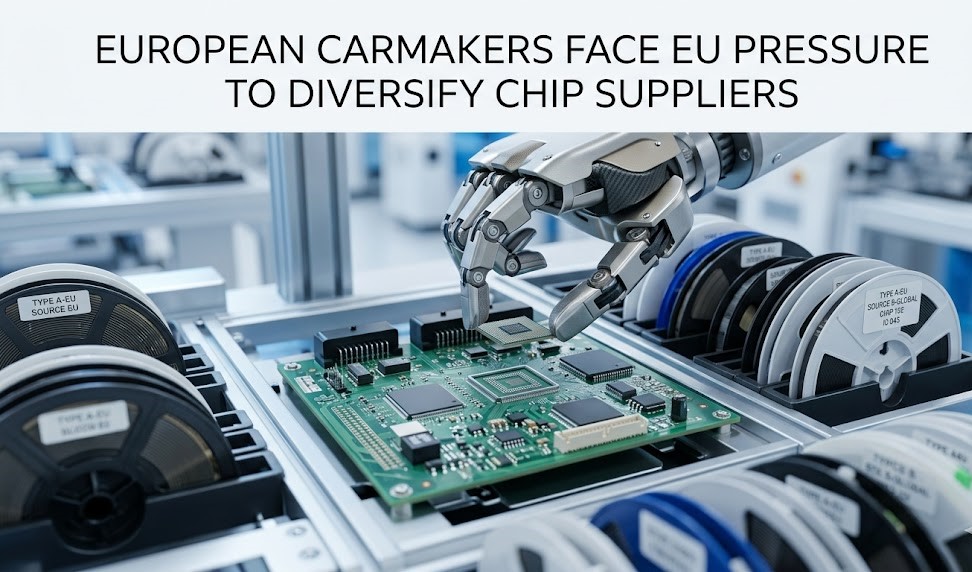

European carmakers will be required to buy chips from at least two suppliers in certain cases and to incorporate supply chain resilience into their procurement decisions, according to a draft law the European Commission is expected to present next month.
After a series of supply chain shocks, the EU is set to impose mandatory measures on the likes of Volkswagen, Stellantis and Renault to prevent excessive dependence on a single chip supplier, most notably from China, according to two EU officials.
The move is being planned as part of a revamp of the bloc’s semiconductor legislation, known as the Chips Act 2, which will be included in a package of legislative proposals to boost the EU’s technological sovereignty.
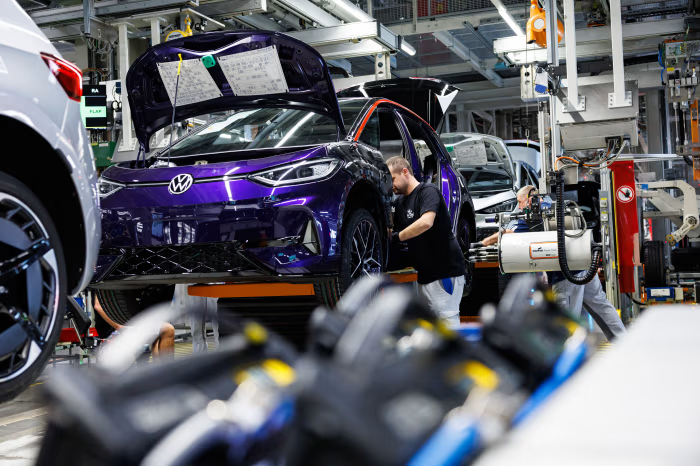
The current version of the bill is still being discussed within the European Commission and might see last-minute changes before it is formally presented on 3 June.
“The Chip Act 2 will reflect today’s technology landscape and geopolitical realities,” Thomas Regnier, the Commission’s spokesperson for tech sovereignty, told Euronews.
The automotive industry has been through a series of supply crises ever since the COVID-19 pandemic triggered a spike in global demand for electronic devices, causing a chip shortage — chips being a fundamental component in cars’ electrical systems.
In response, the European Commission presented the first Chips Act, which included measures to anticipate and mitigate supply chain crises across a range of critical sectors, such as energy, banking and defence.
At the time the law was being negotiated, however, car manufacturers were not subjected to the strictest obligations, which require economic operators to share information and show they have taken steps to prevent shortages.
Now, EU officials appear to think the time for recommendations has passed. The automotive industry must face binding rules because it has not, in their view, learned the lesson.
The main catalyst for this shift in policymakers’ thinking is Nexperia, a Netherlands-based chipmaker acquired in 2019 by Wingtech, a Chinese partially state-owned manufacturing giant.
The acquisition was cleared at the time: Nexperia produces relatively basic semiconductors, including those used in car lights. Even so, the Dutch company held an estimated 10% of the global market share and up to 40% of the European automotive market.
In December 2024, Wingtech was placed on the US sanctions list due to the potential military applications of its chips. The blacklisting was later extended to affiliated companies, including Nexperia.
The Dutch government subsequently seized temporary control of the company to prevent the transfer of technology and assets to China. Beijing responded by halting exports of Nexperia chips produced in China, triggering a shortage in the automotive supply chain across Europe and beyond.
The situation was eventually resolved following a de-escalation of trade tensions between the US and China, which prompted Beijing to lift its export restrictions in November. The automotive industry, however, is still recovering.
The Nexperia episode cemented Brussels’ conviction that the car industry will keep hitting the same wall. Following China’s export ban, major European manufacturers had stockpiles lasting only a couple of months.
For EU policymakers, forcing the industry to diversify chip suppliers is meant to bolster Europe’s strategic autonomy by reducing overreliance on a single provider and boosting demand for European production.
“When it comes to semiconductors, resilience and technological sovereignty are absolutely crucial,” Regnier said, adding that the proposal will not mean more regulatory burden for companies.
The European Commission has consistently made supply chain risk a pillar of its economic security agenda, pushing European companies to decouple from vendors considered risky, most notably those linked to a hostile power such as China.
Supplier diversification, however, carries an economic cost, not least because many Chinese providers are heavily state-subsidised, undercutting competitors and tightening their grip on key supply chain chokepoints.
The proposed legislation would therefore require carmakers to weigh supply chain risks when making procurement decisions, meaning geopolitical factors must enter the equation, not just economic ones.
For the car industry, that lesson may finally be non-negotiable.
Also Read : 12 European Road Trips That Inspire Wanderlust