
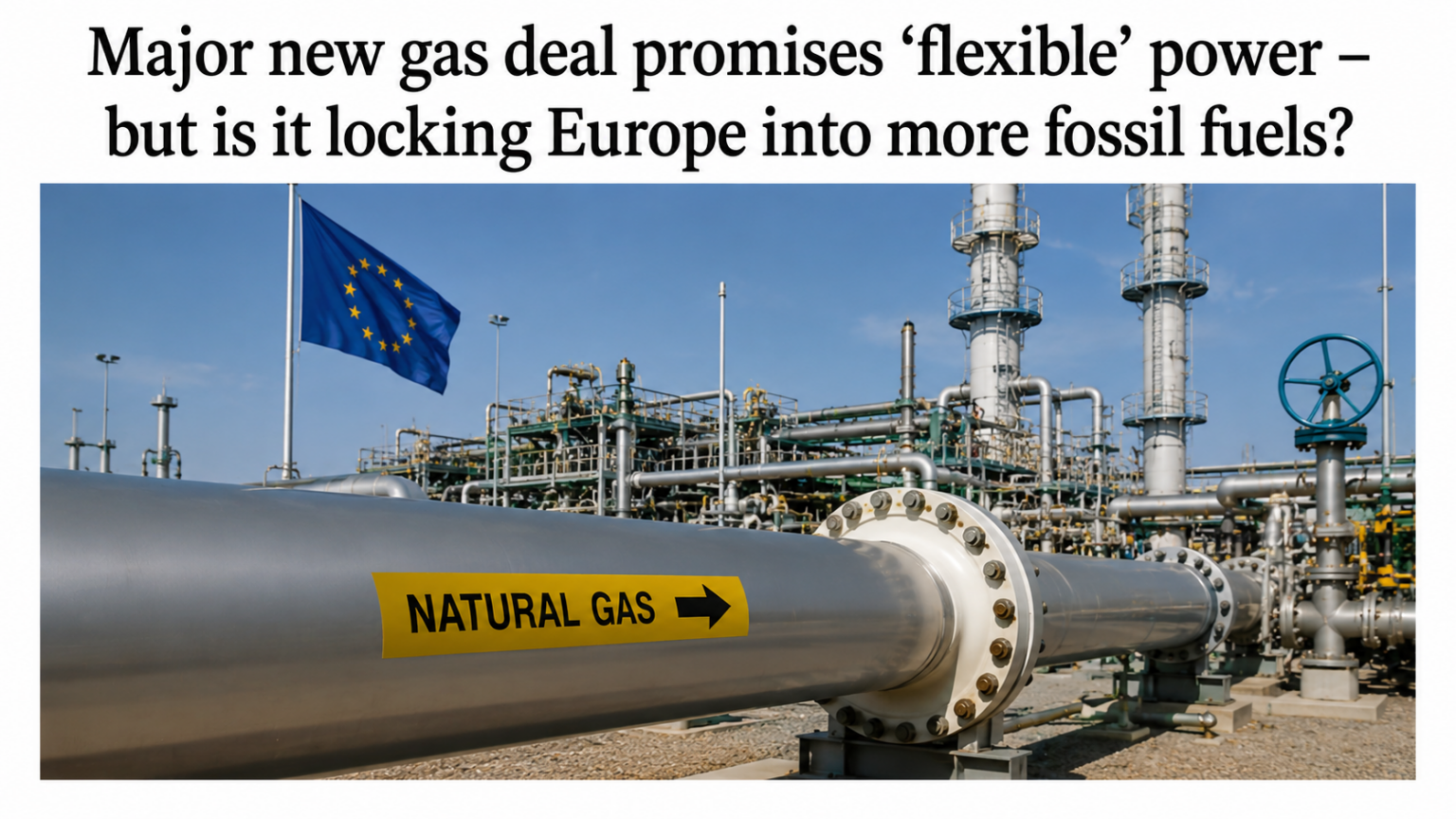

A French oil major and Czech energy group have teamed up to create one of Europe’s largest gas power producers.
They say the deal is a response to Europe’s need for ‘flexible’ power generation – backup power that can be switched on when wind or solar output dips. But critics warn it could instead lock the continent into another decade of fossil fuel dependence.
The partnership, finalised on 29 April, gives TotalEnergies a 50 per cent stake in EPH’s flexible power generation portfolio across France, Ireland, Italy, the Netherlands and the UK. It includes 14 gigawatts of operational and under-construction power assets, 12.5 GW of which will be fossil gas-fired – equivalent to the entire gas power capacity of Belgium, Denmark, Portugal and Sweden combined.
In exchange, EPH received shares in TotalEnergies worth around €5.1 billion, making it one of the French company’s largest shareholders.
A new report by campaign group Beyond Fossil Fuels (BFF) warns that the venture could “deepen Europe’s dependence on costly imported fossil gas, increase energy bills and slow down Europe’s clean energy transition”.
Will the joint venture help stabilise Europe’s power supplies?
TotalEnergies has described the acquisition as central to its ‘Clean Firm Power’ initiative, which promises to deliver round-the-clock, low-carbon electricity to industrial clients by combining intermittent renewable energy with flexible assets like gas-fired power plants.
The BFF report highlights that 87 per cent of the joint venture’s gas units in operation or under construction use combined cycle gas turbine (CCGT) technology, which is designed mainly for sustained, efficient ‘baseload’ energy generation rather than rapid response.
CCGT plants take longer to start up and are better suited to running at relatively stable output over many hours. Research by French non-profit Reclaim Finance has shown that when used for flexible demand, CCGT durability and profitability drop and their CO2 and air pollutants emissions increase.
Open cycle gas turbines (OCGT), which can start up and reach maximum power in just a few minutes, are typically preferred for rapid backup to balance the grid. Of the operational plants in the joint venture, only two – Trapani in Sicily and Kilroot in the UK – are OCGTs.
The criticism is contested, however. London-based energy markets consultancy Timera Energy notes that while open cycle turbines respond faster and are better suited to multiple daily starts, combined cycle plants burn less gas and emit less CO2 per unit of electricity generated.
EP Group made this point when contacted for comment, adding that all new-build projects are designed to be hydrogen-ready.
Does gas still have a place in Europe’s power mix?
Gas does still play a significant role in European grid management. With renewable energy sources like wind and solar subject to uncontrollable dips, gas-fired plants are able to ramp up quickly to bridge gaps in supply.
Natural gas consumption for power generation rose nearly eight per cent in Europe in 2025, driven in part by periods of low wind and hydro output, according to the International Energy Agency (IEA).
ENTSO-E, the body representing European grid operators, says flexible generation is “essential to ensure a secure, efficient, and resilient European power system as the share of renewables continues to grow”. But in a November 2025 report, it concludes that storage, smarter grid management, and unlocking flexibility from renewables themselves are the long-term answer to meeting climate targets while maintaining reliability.
Related
- Europe’s energy grid can’t keep up with the renewables boom. Which country will suffer the most?
- Worst-case global warming projection cut by 1°C as cheap solar and wind slash emissions
For now, European governments offer ‘capacity’ subsidies to power producers to keep plants available so they can guarantee electricity supplies when the grid is under stress. These can also go to energy storage facilities.
Beyond Fossil Fuels has found that approximately €90 billion was allocated to capacity payments in Europe between 2014 and 2024, with more than half given to gas and other fossil fuel assets.
The TotalEnergies and EPH joint venture, named TTEP, is likely to rely heavily on these, despite the apparent unsuitability of its portfolio, BFF warns.
In its November 2025 investor presentation on the deal, TotalEnergies referred to Italy’s “attractive capacity remuneration mechanism” and the UK’s “attractive capacity market”.
In its new report, BFF claims that more than half of the plants included in the joint venture were financed by capacity market subsidies between 2015 and 2024, totalling more than €4.08 billion.
‘TotalEnergies and EPH will be engineering further dependency on fossil gas’
The deal also serves TotalEnergies’ core gas trading business. The company estimates the joint venture will consume around two million tonnes of LNG per year, effectively giving it a guaranteed internal market for gas it sources globally. Rather than competing to sell that gas on the open market, it can sell it to its own power plants – collecting revenue at both the supply and generation ends of the chain.
“Everyone loses in this deal – except the oil and gas companies already cashing in big,” says BFF campaigner Brigitte Alarcon. “Far from putting Europe on the path of energy security, TotalEnergies and EPH will be engineering further dependency on fossil gas… under the bogus pretence of adding ‘flexgen’ capacity.”
BFF estimates that, over a five year period, these imports could cost Europe between €6.68 billion and €7.56 billion, benefiting mostly the US and Russian fossil industries. In the same time period, it estimates that the joint venture could produce climate emissions rivaling those Ireland or Denmark produce in a year.
Related
TotalEnergies found guilty of misleading climate claims
Questions have previously arisen about both companies’ stated ambitions. In October 2025, a Paris court found TotalEnergies’ climate advertising illegal, ruling that its claims to have “climate at the heart of its strategy” were misleading given the company’s continued expansion of oil and gas production.
The company plans to increase LNG production by three per cent per year up until 2030 and has the largest short-term fossil fuel expansion plans – measured by number of countries – of any oil and gas major.
EPH, meanwhile, is controlled by Czech billionaire Daniel Křetínský and remains, through its parent EP Group, the largest coal producer in Europe. The company has said it will exit coal by 2030, though it has transferred rather than closed many of its coal assets – moving them to a sister company, EP Energy Transition, while maintaining shared personnel, infrastructure and financial links, according to an investigation published in 2025 by the financial intelligence NGO FIND.
When contacted for comment, a spokesperson for EP Group said that EP Group said EPH and EP Energy Transition are “structurally and financially independent” and that profits from LEAG – the east German lignite company EPH transferred to a sister entity in 2023 – are fully reinvested into green transformation rather than paid as dividends.
They said the aim of the restructure was to “streamline and accelerate the complex transformation of coal assets toward a sustainable model”.
What does the deal mean for Europe’s energy security?
BFF, whose report on the joint venture was published ahead of the TotalEnergies AGM on 29 May, argues that the deal deepens rather than resolves Europe’s energy insecurity – substituting dependence on Russian pipeline gas for dependence on globally-traded LNG that is equally subject to geopolitical disruption and price volatility.
“This alliance between EPH, Europe’s leading gas power developer, and TotalEnergies, Europe’s biggest LNG importer, is designed to ensure these companies continue to profit from, and prolong Europe’s dependence on fossil gas – fuelling the climate crisis and destabilising the economy,” says Rémi Hermant, a campaigner at NGO Reclaim Finance, which collaborates with BFF.
“As governments increasingly look towards a more secure energy future that does not rely on gas imports, the warning lights should be flashing for the banks. They would be wise to exclude any financial support for TTEP, and for companies developing new gas-fired power plants.”
TotalEnergies was approached for comment.
Also Read : Zara Larsson Declares War on Wikipedia Over Her Profile Picture
