By using this site, you agree to the Privacy Policy and Terms of Use.
Accept
EU News And UpdatesEU News And UpdatesEU News And Updates
Notification Show More
Font ResizerAa
  • Latest
  • Business
  • Sports
  • Technology
  • Entertainment
  • Travel
Reading: The Silverpit “Silver Bullet”: Scientists Confirm Asteroid Impact Beneath the North Sea
Share
Font ResizerAa
EU News And UpdatesEU News And Updates
  • Latest
  • Business
  • Sports
  • Technology
  • Entertainment
  • Travel
Search
  • Latest
  • Business
  • Sports
  • Technology
  • Entertainment
  • Travel
Have an existing account? Sign In
Follow US
Home » Blog » The Silverpit “Silver Bullet”: Scientists Confirm Asteroid Impact Beneath the North Sea
North Sea Asteroid Impact Confirmed: 330-Foot Tsunami Explained
News

The Silverpit “Silver Bullet”: Scientists Confirm Asteroid Impact Beneath the North Sea

Oliver Bennett
Last updated: March 15, 2026 4:48 pm
Oliver Bennett
Published: March 15, 2026
Share
SHARE

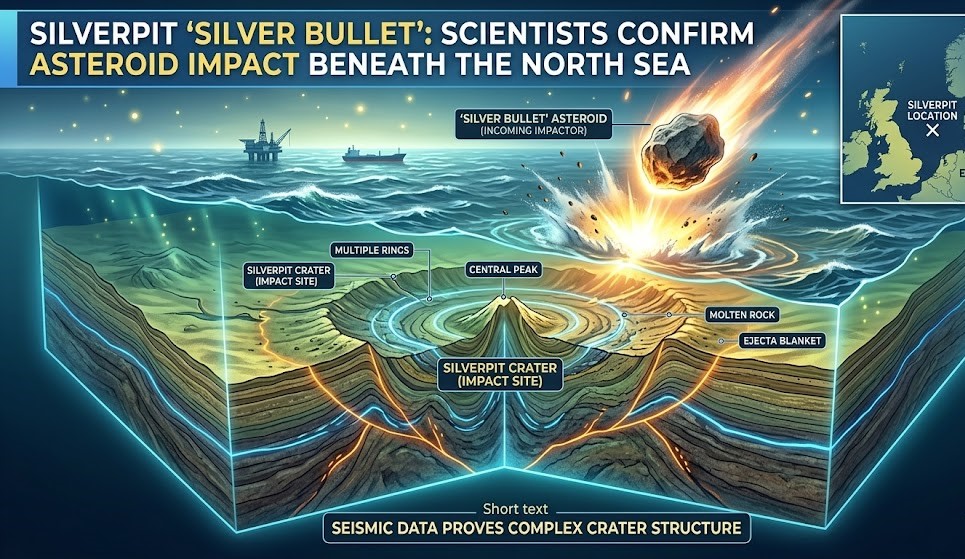
For over two decades, geologists have debated the origin of the Silverpit Crater, a massive circular depression hidden 700 meters beneath the North Sea. On Wednesday, a research team led by Dr. Uisdean Nicholson of Heriot-Watt University announced they have finally found the “silver bullet” evidence to settle the dispute: the structure was caused by a high-velocity asteroid impact roughly 43 to 46 million years ago.

Contents
Resolving a 20-Year Scientific DisputeThe Smoking Gun: Shocked MineralsThe Cataclysm: A 330-Foot TsunamiWhy This Discovery MattersScientific Context & Resources

Resolving a 20-Year Scientific Dispute

Since its discovery in 2002 about 80 miles off the coast of Yorkshire, Silverpit’s origin remained a mystery. While some argued for an asteroid strike, others believed the 20-kilometer-wide ring of faults resulted from underground salt movement or volcanic collapse.

The turning point came through a combination of high-resolution seismic imaging and microscopic analysis of rock fragments recovered from a nearby oil well.

The Smoking Gun: Shocked Minerals

The definitive proof lay in the discovery of rare “shocked” quartz and feldspar crystals.

  • Extreme Pressure: These minerals only develop a specific crystalline fabric when subjected to the extreme shock pressures of an extraterrestrial impact.
  • “Needle in a Haystack”: Dr. Nicholson described the search as a massive effort that yielded the crucial proof needed to overturn a 2009 geological consensus that had previously rejected the impact theory.

The Cataclysm: A 330-Foot Tsunami

Computer simulations conducted by Professor Gareth Collins of Imperial College London allowed the team to reconstruct the violent event.

  • The Impact: A 160-meter-wide asteroid slammed into the shallow sea at a low angle from the west.
  • The Explosion: The strike instantly vaporized water and rock, sending a 1.5-kilometer-high curtain of debris into the atmosphere.
  • The Tsunami: The collapse of this debris plume triggered a massive tsunami, with waves reaching over 100 meters (330 feet) in height, devastating the surrounding Eocene-era coastlines.

Why This Discovery Matters

Silverpit is now one of only 33 confirmed impact craters identified beneath the ocean (out of roughly 200 known on Earth). Because our planet is geologically active, plate tectonics and erosion typically erase these “scars,” making Silverpit an exceptionally rare and well-preserved site.

“We can use these findings to understand how asteroid impacts shaped our planet throughout history, as well as predict what could happen should we have an asteroid collision in the future.” — Dr. Uisdean Nicholson

Scientific Context & Resources

  • Nature Communications: Read the full peer-reviewed study, “Multiple lines of evidence for a hypervelocity impact origin for the Silverpit Crater.”

  • Heriot-Watt University School of Energy & Geosciences: For more on Dr. Nicholson’s work on the Silverpit and Nadir craters.
  • Imperial College London: Impact Modelling: Insights into the numerical simulations of hypervelocity impacts on planetary surfaces.
  • NASA Center for Near Earth Object Studies (CNEOS): Data on modern asteroid trajectories and the history of impacts on Earth.
  • British Geological Survey (BGS): Resources on the geological mapping and history of the North Sea basin.

Also Read : Nygren Goal Seals Narrow Celtic Win Over Falkirk

Sean Baker & Michelle Yeoh to Premiere Short Film ‘Sandiwara’ at Berlin Film Festival
Mexico’s Most Wanted Drug Lord ‘El Mencho’ Killed in Military Raid
The 2025 Met Gala Red Carpet: “Superfine: Tailoring Black Style”
BBC Proposes Licence Fee Cut in Exchange for Funding Reform (2026)
Leo Woodall in Netflix’s Vladimir: A Subversive Campus Comedy (2026)
TAGGED:330-foot tsunamiDr. Uisdean NicholsonHeriot-Watt University.North Sea asteroidshocked quartzSilverpit Crater
Share This Article
Facebook Email Print

Follow US

Find US on Social Medias
FacebookLike
XFollow
YoutubeSubscribe
TelegramFollow
Popular News
World News

French Football Legend Rolland Courbis Dies at 72

skynet
skynet
January 13, 2026
Viral German Black Forest Cake Recipe (Classic, Moist & Better Than Bakery)
The 10 Best Ski Resorts for Non-Skiers in Europe
Top Low-Cost Airlines in Europe (2025)
India Tunes Up for Super 8s with Hard-Fought Win Over Netherlands

About US

Our website delivers fast, reliable, and comprehensive updates from across the European Union. From politics and economy to technology, culture, lifestyle, and policy changes, we cover every major development that shapes the EU.
Quick Link
  • About Us
  • Contact Us
  • Privacy Policy
  • Terms and Conditions
  • Cookie Policy
  • Disclaimer
  • Sitemaps
Top Categories
  • Technology
  • Business
  • Sports
  • News
  • Travel
  • Entertainment

Subscribe US

 Managed By WebProxima Web Agency

© EUFeeds 2026. All Rights Reserved.
Welcome Back!

Sign in to your account

Username or Email Address
Password

Lost your password?