

Voters in Switzerland have rejected a proposal to limit the country’s population to 10 million.
Results showed nearly 55% of participants voted against and 45% voted for, with a turnout of 60% of the population.
The proposal came from the right-wing Swiss People’s Party, which has long campaigned on an anti-immigration platform.
The divisive vote risked putting the country’s free movement agreement with the European Union in jeopardy and was opposed by the government, Swiss businesses, and all the other major parties.
Welcoming the no vote, Switzerland’s justice minister Beat Jans said it was “a sign of stability, openness and reliability”.
Switzerland’s population has grown rapidly since 2002, when it stood at 7.3 million. Now it is 9.1 million, 27% of whom are not Swiss citizens.
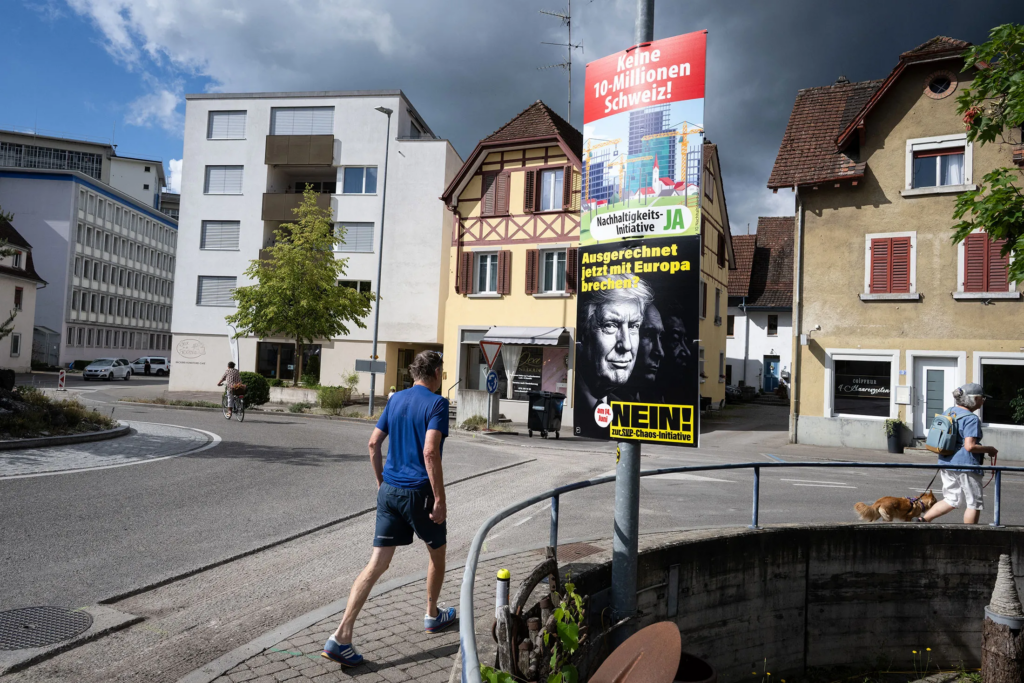
However, the People Party’s argument that capping the population would reduce pressure on transport, housing and the environment seem not to have persuaded enough voters.
Although the Swiss People’s Party insisted the population cap was designed to protect Switzerland’s public services and its environment, it has a long history of campaigning on an anti-immigrant platform, frequently blaming asylum seekers and minorities for societal problems.
Some voters were seemingly worried at the prospect of losing much-needed workers in tourism, hospitals, and care homes.
Others, in particular Swiss business leaders, feared losing Switzerland’s crucial access to Europe’s single market.
Over half of all Swiss products are sold into the EU, but their access to Europe’s markets depends on Swiss commitment to Europe’s free movement of people. Had the population cap been approved, Switzerland would have had to terminate that agreement.
Both the Swiss government and Swiss business leaders say the vote shows non-EU member Switzerland wants to stay close to Europe.
The President of the European Commission, Ursula von der Leyen, had stayed out of the campaign, but welcomed the result once the votes were counted, saying: “The Swiss people have spoken. The EU and Switzerland share deep ties and a strong partnership”.
But the concerns over high rents, over development, crowded public transport, and rising health costs will not go away because of this particular decision.
Marcel Dettling, the Swiss People’s Party’s president, said the vote showed that “the population wants solutions. Not a single problem has been solved”.
What the Swiss voters have shown though, is that many of them may be weary of the People’s Party’s continued focus on immigration as the source of Switzerland’s problems, while voters themselves are not at all convinced that blaming immigrants, or stricter controls on immigration, are the way to solve them.
Switzerland’s system of direct democracy means all major decisions are taken via the ballot box. Campaigners simply have to gather 100,000 signatures to ensure a nationwide vote.

Two young politicians with opposing views on limiting the Swiss population spoke to the BBC prior to the vote.
“We have lost control,” complains Nils Fiechter, 29, who represents the Swiss People’s Party in canton Bern’s parliament.
“Unchecked immigration is leading to Switzerland no longer being Switzerland,” he said.
In 2022, Fiechter and his co-president of the People’s Party’s youth wing were convicted of racial discrimination by the Swiss Federal Court, in relation to a poster they distributed in 2018 targeting Roma and traveller communities.
He believes Switzerland’s problems, which he says include a “housing shortage, gridlocked traffic, overburdened schools and strained social services”, are a direct result of immigration.
But Helin Genis, a 31-year-old Social Democrat elected to Bern city council, dismissed these arguments as scapegoating.
She told BBC News: “It is not migrants who determine rent levels. It is not migrants who raise health insurance premiums. Nor is it migrants who make political decisions on housing, infrastructure or social investment.”
Viewing problems “through the lens of migration does not lead to solutions, but to division”, she added.
The results showed a marked difference between urban and rural areas.
Only Swiss citizens were allowed to vote, but in the cities, which have larger immigrant communities than in the countryside, the proposal got a particularly resounding no.
In the capital city Bern, for example, almost 84% of those voting rejected a population cap.
And key tourism areas, where hotels and restaurants depend on foreign labour, were also not impressed with the proposal.
Both canton Graubunden, home to St Moritz, and canton Valais, home to Zermatt and the iconic Matterhorn, said no.
The prospect of the population cap caused alarm at Switzerland’s business association, Economiesuisse.
ADVERTISING
Its chief economist Rudolf Minsch said that if the motion passed, Switzerland “could face challenges in our relations with the European Union”.
Brussels has long warned non-EU members that they cannot cherry-pick the advantages of the EU’s single market, and wriggle out of commitments like free movement of people.
“The EU is still by far the most important trading partner for Switzerland,” explains Minsch, adding that is it is “in our interest to have stable and clear relationships with our main trading partner”.
Swiss employers were also worried about labour shortages, and losing access to a Europe-wide pool of skilled workers.
Half of all those who work in Switzerland’s hotels are immigrants. Hospitals and care homes are also reliant on foreign workers.
The Swiss People’s Party argued that immigration to Switzerland is fuelling an ever-increasing demand for more hospital beds and more places in schools, and that limiting immigration would ease the pressure.
Opponents said this is unrealistic, pointing to 20% of the Swiss population now being over 65.
Young workers, and young taxpayers, are required to staff and fund the needs of an ageing population – and Switzerland is not creating those young workers itself, they warned.
Also Read : Viral Portuguese Pastel de Nata Recipe (Creamy Custard Tarts, Crispy Shell)