
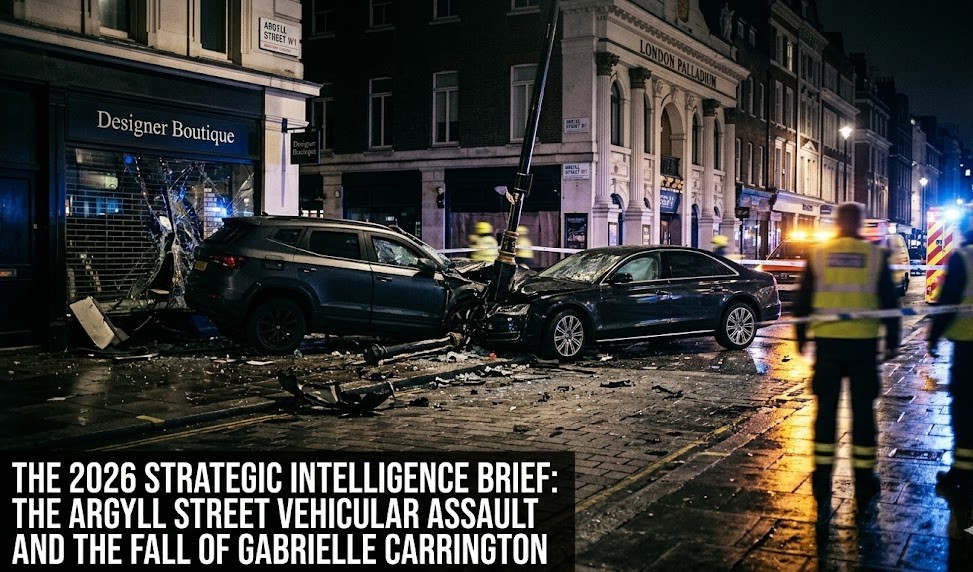

In the early hours of April 19, 2026, London’s Soho district became the site of a high-profile vehicular assault outside the Inca nightclub on Argyll Street. Gabrielle Carrington—a 29-year-old former X Factor finalist and prominent social media influencer—was arrested and subsequently charged with attempted murder after driving her Mercedes into a crowd following a physical altercation. The incident left fellow influencer Klaudia Zakrzewska in a life-threatening condition, alongside a severely injured e-scooter user and a security guard. This intelligence brief deconstructs the legal mechanics, sociocultural implications, and brand economics of a violent crisis at the intersection of London nightlife and influencer culture.

1. Historical Context and Foundational Evolution
Gabrielle Carrington’s public profile originated in the highly manufactured era of 2010s reality television. Appearing on the 2013 season of The X Factor as part of the girl group Miss Dynamix, she later successfully pivoted from reality TV contestant to the modern “Instagram Influencer” archetype, amassing over 360,000 followers under the handle RIELLEUK. Her alleged victim, Klaudia Zakrzewska (known digitally as Klaudiaglam), operates within the same high-visibility digital ecosystem. The transition of these personalities from curated online luxury to a violent, real-world confrontation on the streets of central London underscores the volatile evolution of influencer culture, where online personas and real-world consequences catastrophically intersect.
2. Technical Mechanics and Legal Architecture
The legal mechanics of the Crown Prosecution Service’s (CPS) case against Carrington are exceptionally severe. The charges—attempted murder, grievous bodily harm (GBH) with intent, actual bodily harm (ABH), dangerous driving, and drink-driving—indicate that prosecutors believe the vehicular strike was deliberate. Forensic analysis of CCTV and witness testimonies suggest Carrington re-entered her vehicle following an altercation, sharply mounted the pavement, and deliberately struck Zakrzewska, dragging her under the chassis before reversing. A breathalyzer test allegedly recorded 61 microgrammes of alcohol per 100ml of breath, nearly twice the legal limit. This compounds the dangerous driving architecture and serves as a foundational pillar in establishing both culpability and intent during her remand at Westminster Magistrates’ Court.
3. Economic Impact and Brand Devaluation
From a macroeconomic perspective, an incident of this magnitude triggers immediate, catastrophic brand devaluation within the influencer economy. Carrington’s monetization pipelines—driven by sponsorships, lifestyle branding, and appearances—have functionally collapsed overnight, triggering instant “morals clause” terminations from associated corporate partners. Furthermore, the incident inflicts localized economic damage on London’s nightlife sector. The Inca nightclub and surrounding Soho venues may face heightened licensing scrutiny, increased insurance premiums for pedestrian liability, and potential mandated investments in hostile vehicle mitigation (HVM) infrastructure, shifting operational expenditures (OPEX) for local hospitality businesses.
4. Sociocultural and Behavioral Implications
The behavioral dynamics of this crisis highlight the dark underbelly of influencer entitlement and alcohol-fueled nightlife. Carrington’s courtroom demeanor on April 21—standing with hands on her hips and making a “heart sign” to her family from the dock while her victim remained in a life-threatening hospital condition—sparked intense sociological outrage. This behavior amplifies public perception of a severe empathy disconnect among social media elites. The viral dissemination of the crash footage across platforms further traumatizes the digital community, turning a localized tragedy into a globally consumed true-crime spectacle driven by algorithmic voyeurism.
5. Regulatory, Ethical, and Security Frameworks
This event forces a critical re-evaluation of urban security frameworks in high-density entertainment districts. While police quickly ruled out terrorism, the ease with which a civilian vehicle was weaponized against pedestrians on Argyll Street exposes structural vulnerabilities in Soho’s traffic management. Ethically, the digital platforms hosting these influencers face pressure to moderate the spread of the graphic crash footage, balancing journalistic public interest against the mandate to protect victims from digital exploitation. Regulators are likely to accelerate debates on pedestrianizing broader swaths of the West End during late-night operational hours to prevent vehicular access altogether.
6. Competitive Analysis and Strategic Positioning
In the highly specialized field of crisis management and litigation PR, Carrington’s strategic positioning is terminally compromised. Defending against an attempted murder charge involving a vehicle requires dismantling the prosecution’s narrative of “intent.” Her legal team will likely attempt to position the alcohol intoxication and the chaotic “melee” outside the club as mitigating factors, arguing panic or loss of spatial control rather than premeditated vehicular assault. However, competing against multi-angle CCTV footage and multiple severely injured bystanders means the defense strategy must pivot entirely from reputation salvage to pure damage limitation and sentence reduction.
7. Predictive Modeling: Future Outlook (2026–2030)
Looking toward the remainder of the decade, the Carrington trial will serve as a watershed legal precedent for vehicular assault in the influencer era. We predict Carrington will face a lengthy custodial sentence, effectively terminating her digital career. Structurally, the Westminster City Council is expected to implement “Zone-Based Traffic Exclusion” (ZBTE) across Soho nightlife hotspots by 2028, physically barricading streets to prevent vehicles from operating near club exits. The “RIELLEUK” incident will be codified in crisis management textbooks as the definitive example of how the toxic convergence of reality TV fame, alcohol, and vehicular negligence can instantly annihilate both digital empires and human lives.

Conclusion
The April 2026 Argyll Street vehicular assault represents a tragic collision between the curated illusions of influencer culture and the brutal reality of criminal violence. Gabrielle Carrington’s trajectory from X Factor finalist to an attempted murder suspect underscores the fragility of digital status when subjected to the rigid, unforgiving architecture of the British legal system. As the victims fight for recovery, the structural fallout will permanently alter Soho’s nightlife security protocols and serve as a stark, cautionary benchmark for brand implosion. The intelligence synthesized here confirms that the consequences of this high-profile crisis will reverberate through London’s legal and entertainment sectors for years to come.
Also Read : Viral German Black Forest Cake Recipe (Classic, Moist & Better Than Bakery)